
Reviewed · BOGOTá TOURS
Anti-tour Bogotá
Bogotá rewards those who ask harder questions. I like the hands-on chicha workshop and the chance to meet people at La Trocha Casa de la Paz, where former FARC combatants are building a new life through art, food, and conversation. The main drawback is the pace: four hours covers several locations, so some stops receive only a short introduction.
I also like the small-group format, limited to 10 people, and the way guides such as Andrés and Michael connect famous names like La Pola and Manu Chao to less polished parts of the city. You should come ready for an urban outing rather than a relaxed sightseeing walk, with public transport, back streets, strong drinks, and serious discussion all part of the mix.
In This Review
- Key points at a glance
- Why this Bogotá tour feels different
- Starting at Parque de los Periodistas
- La Pola and the short lesson in independence
- Chorro de Quevedo and the chicha workshop
- A door into La Candelaria’s less expected stories
- Crossing Bogotá on TransMilenio
- La Trocha Casa de la Paz and the work of rebuilding
- What the guides add to the experience
- Who should book this $42 experience?
- Practical advice before you go
- Should you book Anti-tour Bogotá?
- FAQ
- Where does the Anti-tour Bogotá experience begin?
- Where does the tour finish?
- How long does the experience last?
- What language is the tour offered in?
- How many people can join the group?
- What is included in the price?
- Is public transport part of the tour?
- Will I taste Colombian drinks?
- What should I bring?
- Can I cancel my booking?
Key points at a glance
- Make chicha at Chorro de Quevedo: Spend about 90 minutes learning about this indigenous corn drink and tasting what you help prepare.
- Visit Manu Chao’s former home: See a little-known La Candelaria location linked to the musician’s time in Bogotá.
- Meet a different side of Colombia at La Trocha: Hear personal stories from former FARC combatants working toward peace.
- Taste ancestral viche: Try a sugarcane spirit at La Casa de la Paz, with the cultural context that gives it meaning.
- Use TransMilenio between tour zones: The public transport ride helps connect central Bogotá with the later community visit.
- Expect a thoughtful, nonstandard city tour: This experience focuses on resistance, inequality, art, and social change rather than a checklist of major sights.
Why this Bogotá tour feels different
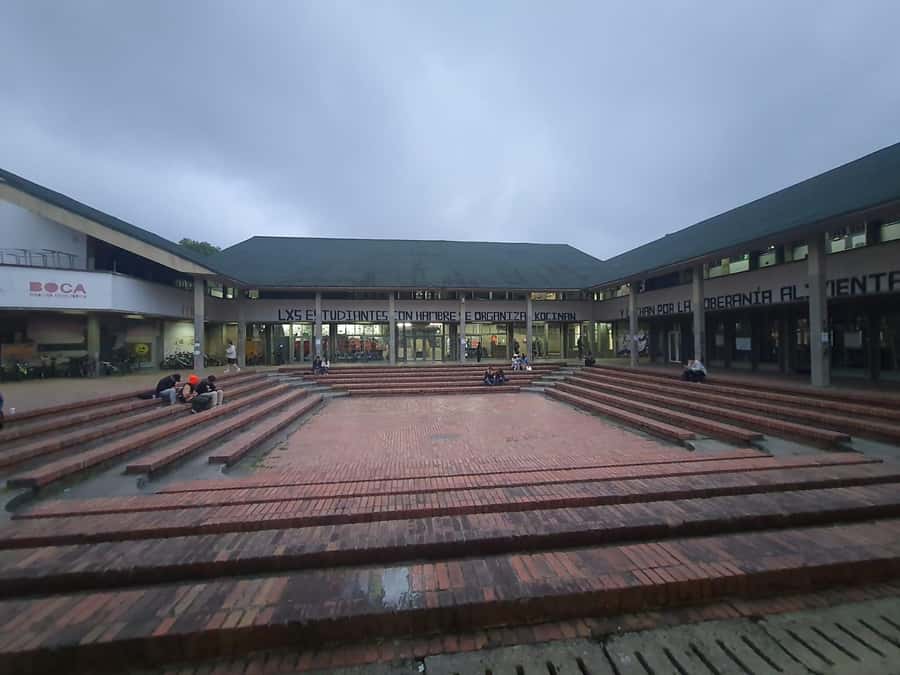
Most first visits to Bogotá focus on museums, churches, food, and the handsome colonial streets of La Candelaria. This experience uses those familiar areas as a doorway into harder subjects: independence, indigenous customs, political violence, displacement, resistance, and reconciliation.
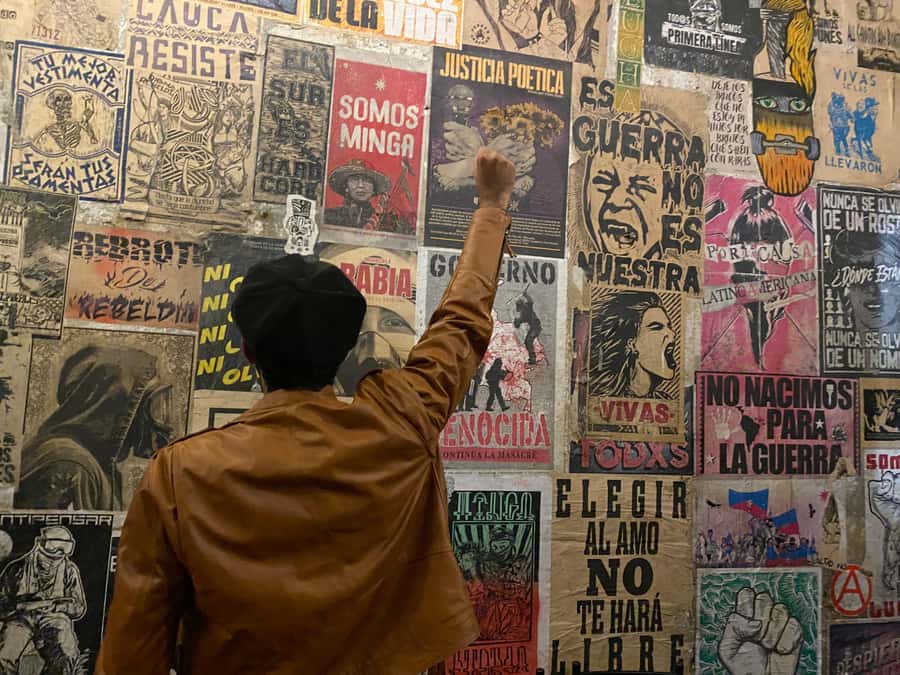
I like that the tour does not treat Bogotá as a polished stage set. You move between monuments, plazas, private cultural spaces, public transport, and a peace project. The result is less about collecting postcard views and more about understanding how different people have fought to shape the city.
The tone can be serious, but it is not all lectures. You make chicha, taste viche, look at crafts, and meet people involved in cultural work. That mix gives the four hours some lift, while still leaving room for difficult questions.
The tour costs $42 per person. That is a fair price if you value a small group, an English-speaking guide, two tastings, entry to the Manu Chao house, and access to a place that would be difficult to understand or arrange on your own. It is less compelling if you want a standard historical tour with long stops at major monuments.
A few more trips worth weighing up before you book
- Bogota: Bicycle City Tour
★ 4.9 · 2,156 reviews - Zipaquirá: Salt Cathedral Group Tour with Pickup
★ 4.8 · 1,606 reviews - Bogotá: Guided La Candelaria Walking Tour
★ 4.8 · 1,229 reviews
Starting at Parque de los Periodistas
The meeting point is in front of the Bogotá sign at Parque de los Periodistas Gabriel García Márquez. This is a useful central starting point, close to the old city and the first historical stops.
Your guide begins by setting up the larger story of Bogotá. The tour centers on people and movements that questioned authority, inequality, and accepted versions of Colombian history. You should expect an interpretive walk, not simply a list of dates and building names.
A small group matters here. With no more than 10 people, it is easier to ask questions and hear personal explanations. It also suits the nature of the tour, since conversations at La Trocha work better around a small table than in a large crowd.
Wear comfortable shoes. You will walk through central Bogotá, move between several places, and use public transport. A hat, sunscreen, water, and a camera are also recommended.
La Pola and the short lesson in independence
The first stop is the monument to Policarpa Salavarrieta, known as La Pola. The guided visit lasts about 15 minutes, so do not expect a full biography. Instead, the guide uses her story to introduce the courage and political tension behind Colombia’s fight for independence.
La Pola is especially useful as an opening subject because she represents resistance in a personal way. Rather than beginning with generals and grand government buildings, you start with a revolutionary heroine whose bravery became part of Colombia’s national memory.
I appreciate the choice of this stop because it gives the tour an emotional starting point. You are not only looking at a statue. You are considering who gets remembered, who takes risks, and how stories of resistance survive.
The short timing is the clear limitation. If La Pola interests you, you may want to learn more separately. On this tour, her role is to frame the rest of the day rather than receive a long historical treatment.
Chorro de Quevedo and the chicha workshop
The tour then heads to Chorro de Quevedo Plaza, one of the liveliest historical corners in La Candelaria. Here, the main activity is a hands-on chicha workshop lasting about an hour and a half.
Chicha is an ancient indigenous corn brew, and making it gives you a direct connection to traditions that are often reduced to a quick mention in a guidebook. You get to take part in the process and taste a drink. That practical element makes the history easier to remember.
I like this section because it links culture to everyday life. Chicha is not presented as a museum object. It is something you prepare, discuss, and sample. The workshop also shows the tension between older indigenous practices and modern attitudes toward regulation, identity, and urban culture.
The long stop gives you time to ask questions and enjoy the social side of the experience. It is also the most hands-on part of the morning, so it will suit you if you prefer doing something over standing quietly beside a monument.
The drink itself may not appeal to everyone. If you dislike fermented beverages, the workshop remains worthwhile for its cultural content, but the tasting may not be your favorite part. Personal expenses are not included, so bring some Colombian pesos or a payment method for anything extra you may want.
A completely different kind of day out around Bogota:
- Bogotá: Private City Tour, Monserrate, Emerald and Botero
★ 4.9 · 798 reviews - Bogotá´s Barrios: El Paraíso Favela Tour with Cable Car
★ 4.8 · 731 reviews - Bogota: Guatavita and Salt Cathedral Daily Group Tour
★ 4.7 · 615 reviews - Bogotá City Tour with Monserrate, Gold and Botero Museums
★ 4.9 · 584 reviews
A door into La Candelaria’s less expected stories
After the workshop, the experience visits the former home of Manu Chao. This is one of the tour’s most unusual stops, especially for music fans and anyone interested in how artists respond to a city.
The visit explores how Manu Chao found inspiration in Bogotá’s streets and how his time here connected with the city’s cultural life. It is not presented as a standard celebrity attraction. The value lies in seeing how a private place can help explain an artist’s relationship with a city.
I like this stop because it shifts the focus from official history to cultural memory. La Candelaria is often treated as a colonial district to photograph, but this visit points toward the musicians, poets, performers, and organizers who give the area its creative edge.
The supplied details call the location Mano Chao House in one place and Manu Chao’s former home elsewhere. When booking, check the exact meeting information and current name used by the operator so you know what to expect.
Crossing Bogotá on TransMilenio
The next leg uses TransMilenio, Bogotá’s iconic bus rapid transit system. The ride is listed at about 12 minutes, followed by a visit to the Gold Museum TransMilenio stop for roughly 30 minutes of guided explanation.
Public transport is not just a practical connection here. It shows you how the tour moves from the historic center toward another part of the city without hiding the ordinary mechanics of getting around Bogotá. You are not sealed inside a private vehicle while the city passes by.
The Gold Museum stop should be viewed as a brief orientation rather than a complete museum visit. The time is too short for a full tour of the collection, but the guide can use the area and its name to connect the old center with the wider city.
This portion may feel less smooth for some people. One person specifically suggested beginning at La Trocha instead, which would reduce the amount of movement before the main community visit. I can understand that view, especially if you prefer a slower start. Still, the public transport section gives the tour a more grounded feel.
La Trocha Casa de la Paz and the work of rebuilding
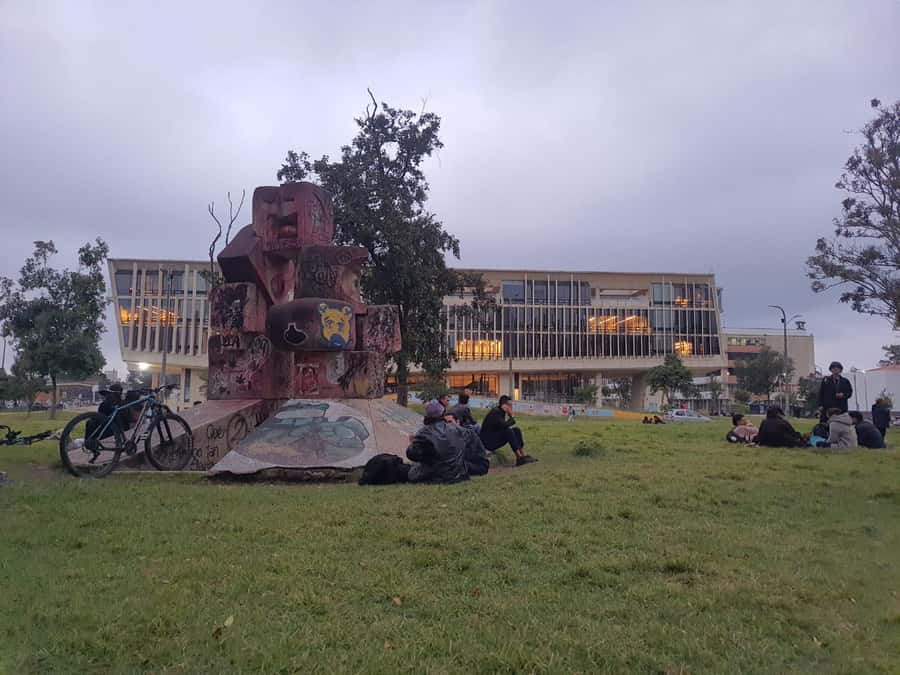
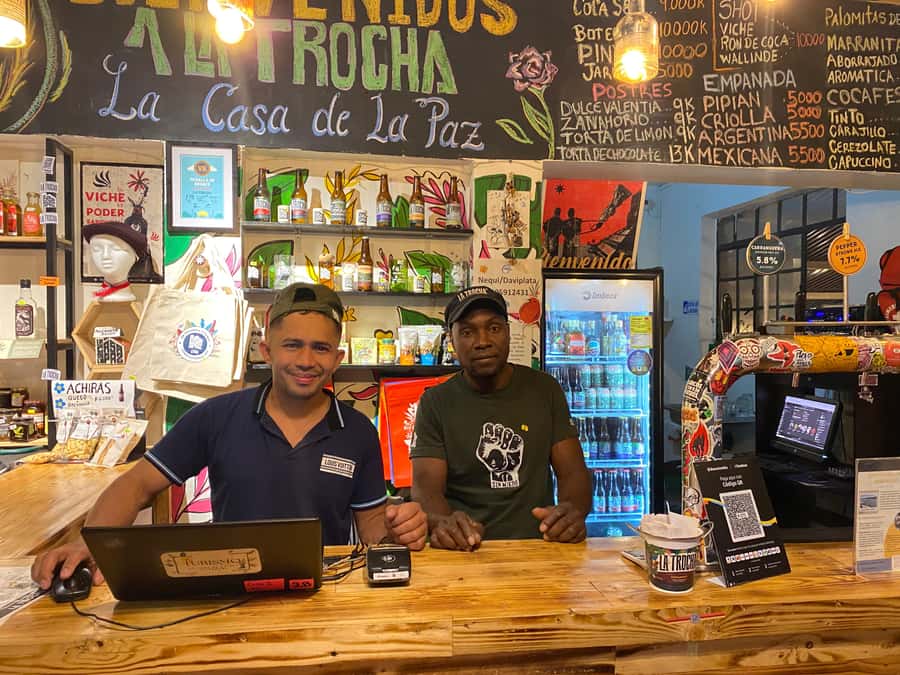
The final major stop is La Trocha Casa de la Paz, where former FARC combatants are involved in projects that support peace and social change. The visit lasts about 80 minutes and includes an arts and crafts market.
This is the heart of the experience. You hear personal stories of transformation and learn how people once involved in armed conflict are trying to build a different future. The focus is not on turning painful history into a spectacle. It is on meeting people through their current work and hearing how they understand the difficult move toward peace.
I value this part because it gives the word reconciliation some human scale. Political agreements can seem distant. A conversation at a peace house, alongside crafts and food, makes the subject more immediate.
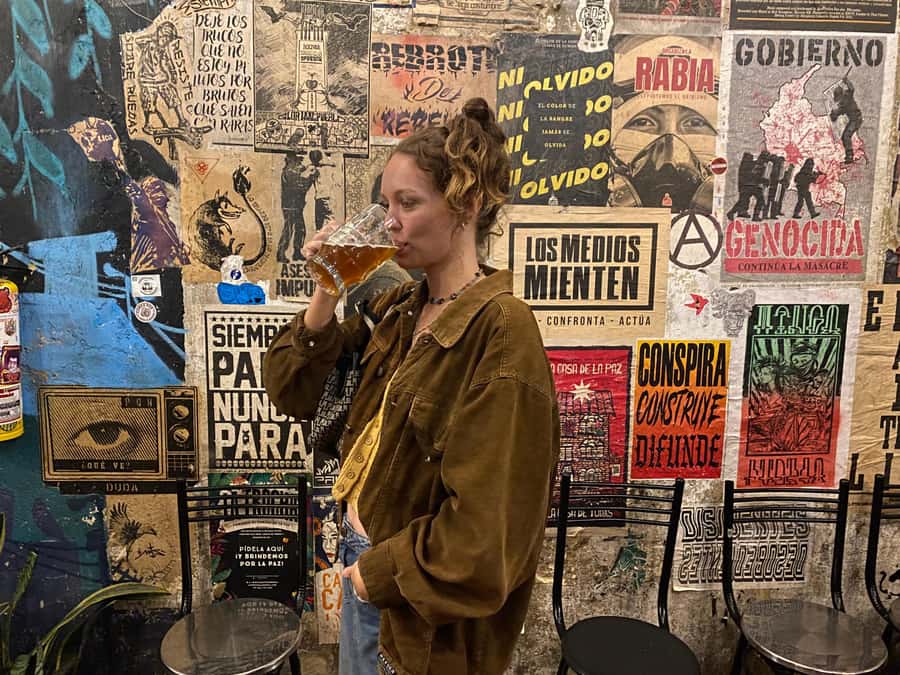
You can also taste viche, an ancestral sugarcane spirit. Like chicha, viche is more than a drink on this tour. It opens a conversation about Colombian traditions, regional identity, and the survival of local practices.
Expect the tone to become more serious here. The stories may raise questions about violence, justice, responsibility, and the possibility of a new beginning. If you want only light entertainment, this could feel heavy. If you want a fuller picture of Colombia, it is likely to be the most valuable hour of the day.
The tour finishes at La Trocha Casa de la Paz. That is useful because you do not need to travel back with the group to the original meeting point. Plan your next activity from this area rather than assuming you will end in central La Candelaria.
What the guides add to the experience
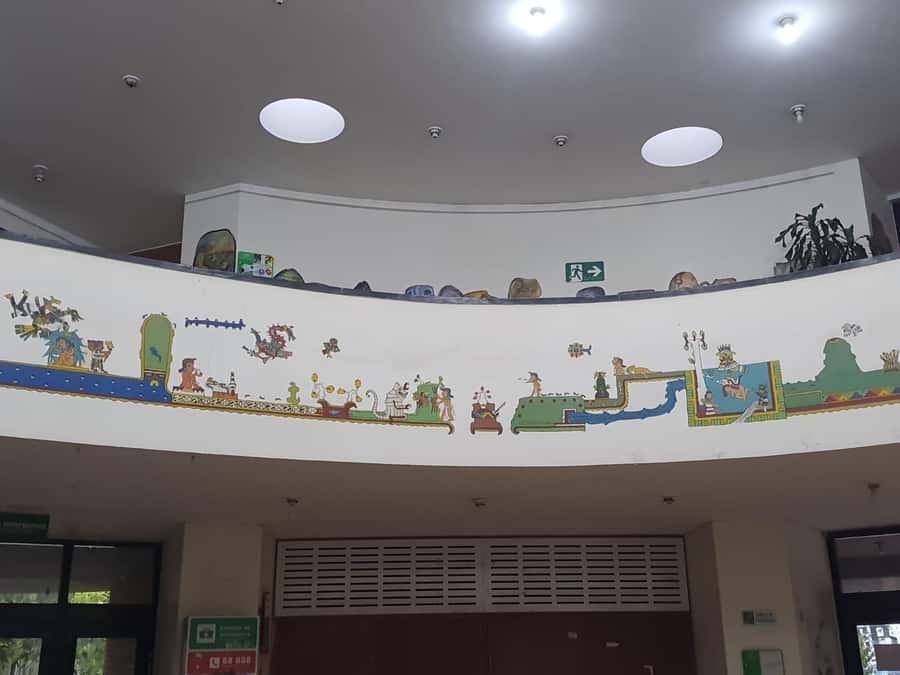
The guide makes a major difference on a tour built around sensitive subjects. Andrés receives repeated praise for making the experience informative, enjoyable, and easy to engage with. Michael is also noted for creating a pleasant and inclusive atmosphere while explaining the city’s overlooked social stories.
Paula, connected with the visit to La Casa de la Paz, is singled out as a particularly strong part of the experience. Her role appears to help turn the final stop from a passive visit into a personal encounter.
Because the tour is offered in English, clear explanation matters. You will want a guide who can handle historical facts, political context, cultural practices, and personal testimony without flattening everything into a simple good-versus-bad story.
The published score is 4.4 out of 5 from 14 ratings. The strongest praise centers on the unusual route, the passion of Andrés and Michael, the chicha activity, and the powerful time at La Casa de la Paz. One low score points to a need for better planning and stronger guiding, so I would keep your expectations flexible. This is a socially focused tour, and its quality depends heavily on the guide and the flow of the day.
Who should book this $42 experience?
I would choose this tour if you have already seen some of Bogotá’s standard sights or if you want your first city experience to include current social issues. It suits people who enjoy conversation, local drinks, community projects, and history told from more than one angle.
It is particularly good for:
- First-time visitors who want context beyond monuments
- Repeat visitors looking for less familiar parts of La Candelaria
- Music fans interested in Manu Chao’s connection to Bogotá
- People curious about indigenous foodways and Colombian spirits
- Anyone interested in peace-building and post-conflict life
- Small groups who prefer discussion over a scripted bus tour
I would think twice if you want a museum-heavy day, a purely architectural walk, or a private vehicle throughout. The schedule includes public transport, a short museum-related stop, several walks, and topics that require attention.
At $42, the value is strongest because you receive access to experiences that are not easy to arrange independently. The chicha workshop, Manu Chao house, viche tasting, and conversation at La Trocha form a package with more substance than a basic walking tour.
Practical advice before you go
Book with the four-hour length in mind. The tour covers Parque de los Periodistas, La Pola, Chorro de Quevedo, the Manu Chao house, the Gold Museum area, and La Trocha. That is a lot of ground and subject matter for one morning or afternoon.
Wear shoes suited to walking and bring water. A hat and sunscreen are sensible in Bogotá’s high-altitude sun, and a camera is useful if photography is permitted at each location.
The experience is offered in English and uses a small group of up to 10 people. Free cancellation is available up to 24 hours before departure, and you can reserve now and pay later, which helps if your Bogotá schedule is still shifting.
The meeting point is in front of the Bogotá sign. Confirm the starting time and exact location before leaving your hotel, since availability determines the departure hour.
Should you book Anti-tour Bogotá?
Book it if you want Bogotá explained through people, resistance, creativity, and attempts at peace rather than through famous buildings alone. The chicha workshop is fun, the Manu Chao connection is unusual, and La Trocha provides the strongest reason to go.
Skip it if your priority is a relaxed sightseeing route with long visits at major attractions. The pace is full, the subjects can be serious, and the experience depends on having a strong guide.
For most curious visitors, I think the $42 price is justified. Come with comfortable shoes, an open mind, and a willingness to listen. You will leave with fewer standard snapshots, but a sharper sense of the city’s complicated character.
FAQ
Where does the Anti-tour Bogotá experience begin?
It begins at Parque de los Periodistas Gabriel García Márquez, in front of the Bogotá sign.
Where does the tour finish?
The tour finishes at La Trocha Casa de la Paz.
How long does the experience last?
The experience lasts four hours.
What language is the tour offered in?
The live tour guide operates in English.
How many people can join the group?
The group is limited to 10 participants.
What is included in the price?
The experience includes a hands-on chicha workshop, viche tasting, personal stories of transformation, entrance to the Manu Chao house, and visits to historical sites.
Is public transport part of the tour?
Yes. The route includes a TransMilenio journey listed at about 12 minutes.
Will I taste Colombian drinks?
Yes. You make and taste chicha during the workshop and also taste viche at La Trocha Casa de la Paz.
What should I bring?
Bring comfortable shoes, a hat, a camera, sunscreen, and water.
Can I cancel my booking?
Yes. You can cancel up to 24 hours in advance for a full refund. You can also reserve now and pay later.
Just added around Bogota
- Zipaquirá: Private Salt Cathedral Mine and Walking Tour★ 4.8 · 3 reviews
- Walking tour José Celestino Mutis Botanical Garden 3 hrs★ 5.0 · 3 reviews
- Bogota: East Hills Mountain Hike★ 4.2 · 3 reviews
- Bogota: Explore the forest and bird watching at Chicaque Natural Park★ 5.0 · 3 reviews
- Fun Graffiti Workshop: The Art of Aerosol and Color★ 5.0 · 3 reviews
- Bogota: Downtown City and Monserrate Hill Private Tour★ 3.7 · 3 reviews
- Bogotá: La Candelaria Food Tour with Tastings★ 4.2 · 3 reviews
- Bogotá: Candelaria Tour with Cacao and Coffee Workshop★ 5.0 · 3 reviews
Bogotá Tours, compared.
Private City Tour, Monserrate, Emerald and Botero
Read our review →
Bogotá´s Barrios: El Paraíso Favela Tour with Cable Car
Read our review →
Bogotá City Tour with Monserrate, Gold and Botero Museums
Read our review →
Zipaquirá Salt Cathedral and Lake Guatavita Day Tour
Read our review →Browse the lists this tour appears in