
Reviewed · MEDELLíN TOURS
Do Not Say That Name
Medellín’s past is impossible to ignore. This four-hour private tour connects the city’s cartel era with its public memorials, cemetery, hillside communities, and long recovery, giving you a more personal look than a large group outing. I especially like the private transportation, which saves time in a hilly city, and the chance to choose a morning or afternoon departure. I also like that a bilingual guide and medical assistance are included. The main concern is guide quality: some visitors received vivid, well-organized storytelling, while others found the English and historical explanations too thin.
The tour costs $78 per person, a fair price if you value door-to-door transport and a private guide. It is less convincing if you expect a nonstop parade of famous cartel locations. Much of the original evidence has disappeared, been rebuilt, or sits far outside Medellín. The best version of this experience treats Pablo Escobar as one part of Medellín’s story, not the whole show.
In This Review
- Key points to know before booking
- What this Medellín tour is really about
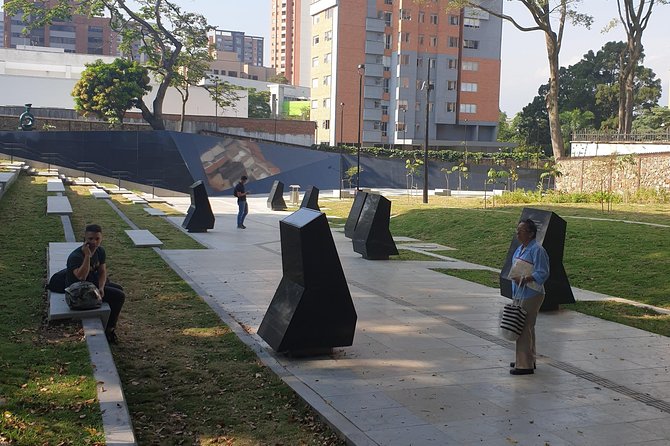
- Parque Memorial Inflexión: a memorial where a fortress once stood
- Jardines Montesacro and the short cemetery visit
- Parque San Antonio and the change in the conflict
- Comuna 13: the part many people remember most
- Cable cars, murals, and the wider Medellín story
- Guide quality can make or break the experience
- Is $78 per person good value?
- Who should book this experience?
- Practical details before you go
- Should you book this Medellín tour?
- FAQ
- How long is the tour?
- How much does the tour cost?
- Is the tour private?
- Is transportation included?
- Is a bilingual guide included?
- Can I choose a morning or afternoon departure?
- Are food and drinks included?
- What is the cancellation policy?
Key points to know before booking
- The Monaco building is gone: The former site is now Parque Memorial Inflexión, a public memorial rather than a preserved cartel landmark.
- The cemetery stop is brief: Jardines Montesacro offers a look at the grave and nearby religious sites, but the visit may not last long.
- Comuna 13 can be the strongest part: Accounts of the experience describe escalators, murals, local stories, and the area’s transformation.
- The tour’s focus can shift: Some guides spend more time on Medellín’s wider history and less on cartel details.
- A private format adds flexibility: You travel only with your group and can ask questions directly.
- English ability matters: Ask for a guide who can explain the chronology clearly if you want detailed history in English.
What this Medellín tour is really about
The title and theme may suggest a tour built around famous cartel sites. In practice, the experience is more useful as a study of Medellín’s violent past and the changes that followed.
The city’s connection to Escobar is unavoidable, but there are limits to what remains. The former Monaco building was destroyed and replaced by Parque Memorial Inflexión. The ranch often associated with him is several hours outside Medellín. The place connected with his death has also been rebuilt.
That makes this a storytelling tour as much as a sightseeing tour. You are not simply walking through preserved crime scenes. You are visiting places where the city has chosen to remember, rebuild, or move on.
I think that distinction matters. If you have watched Narcos, you may arrive with a list of expected locations and dramatic details. A good guide should help you separate television fiction from documented events, then show how Medellín’s neighborhoods changed after years of conflict.
The private format is useful here. With only your group, you can ask how a particular location connects to the larger story. You can also ask the guide to slow down, clarify names, or spend less time on a stop that does not interest you.
A few more trips worth weighing up before you book
- Medellin: Comuna 13 Graffiti Tour, Cable Car & Street Food
★ 4.8 · 9,046 reviews - Medellín: The Real Pablo Escobar Tour
★ 4.8 · 3,205 reviews - Medellín: Comuna 13 True Story and Street Food Tour
★ 4.9 · 1,779 reviews
Parque Memorial Inflexión: a memorial where a fortress once stood
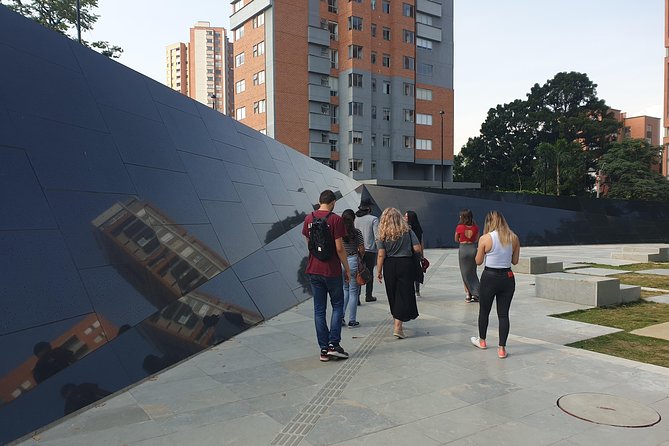
The first named stop is Parque Memorial Inflexión, with about 15 minutes planned and no admission fee.
This public space occupies the former site of Edificio Mónaco, once associated with Escobar and the violence of Medellín’s cartel years. The building itself is no longer there. That fact shapes the visit: you are seeing a memorial to a painful period, not an intact mansion or dramatic crime scene.
The park’s importance comes from what it represents. A place once linked with fear has been given a public, reflective purpose. That change says a great deal about Medellín’s effort to address its past without turning it into a shrine to criminal power.
Fifteen minutes is enough to see the site and hear a short explanation, but not enough for a long historical lecture. If this stop matters to you, ask your guide for a clear timeline. Ask what happened at the former building, why it was removed, and how the memorial fits into the city’s wider effort to remember victims.
One nearby point is described as a shrine to the Virgin Mary, where pilgrims ask for miracles. It adds a different layer to the stop. The city’s difficult history is not only told through official monuments. It also appears in places of faith, grief, and personal hope.
Jardines Montesacro and the short cemetery visit
The tour continues to Cementerio Jardines Montesacro, with roughly 20 minutes planned and no admission fee.
This is a short cemetery stop, centered on the grave connected with the tour’s main subject. You should expect a visit of limited duration rather than a long walk through the entire cemetery. The value depends heavily on the guide’s ability to explain who is buried there, what the grave represents, and how the person’s story fits into Medellín’s conflict.
A cemetery can easily become a quick photo stop. It should be more than that. The right guide can explain how public memory works in Colombia, why some graves attract attention, and how families and communities remember a violent era.
The experience may also touch on other figures connected to the period, including Griselda Blanco, sometimes called the Black Widow. If that subject interests you, ask directly for context. The stop itself will not necessarily provide a full account unless the guide chooses to explain it.
This is one of the places where guide quality makes a major difference. A strong guide can turn 20 minutes into a concise, gripping lesson. A weak guide may point out a grave, offer a few disconnected facts, and move on.
Parque San Antonio and the change in the conflict
Parque San Antonio is listed as another 15-minute stop. Here, the guide explains the change in the war against Escobar.
The site is useful because it shifts attention from one man to the wider city. Medellín’s conflict involved changing alliances, state action, rival criminal groups, and communities caught in the middle. A short stop cannot cover every part of that story, but it can help you understand that the city’s violence did not follow one simple storyline.
This is a good place to ask for dates and sequence. What changed first? Which groups were involved? How did the city’s response develop? If the guide answers in broad terms only, you may leave with the setting but not the full picture.
The park itself is also a reminder that public spaces carry layers of meaning. Your guide may connect this stop with the city’s shift away from open conflict and toward public projects, transportation improvements, and neighborhood renewal.
A completely different kind of day out around Medellin:
- Medellín: Comuna 13 District Tour with Cable Car Ride
★ 4.8 · 1,467 reviews - Medellin: Coffee Tour with Transport, Snacks and Tastings
★ 4.7 · 1,357 reviews - From Medellín: Paragliding Tour with GoPro Photos & Videos
★ 4.9 · 1,210 reviews - Tour Guatapé
★ 5.0 · 865 reviews
Comuna 13: the part many people remember most
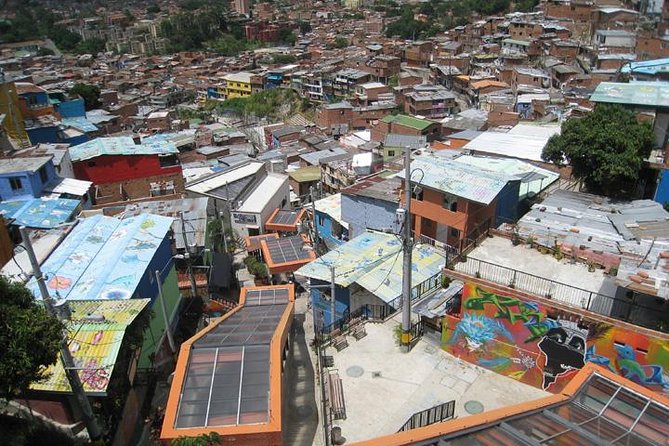
Although the basic stop list names Parque Memorial Inflexión, the cemetery, and Parque San Antonio, accounts of this experience also describe visits to Comuna 13, its outdoor escalators, murals, and nearby cable transportation. Confirm the exact route before you book, because this appears to be an important part of some versions of the tour but is not fully detailed in the supplied itinerary.
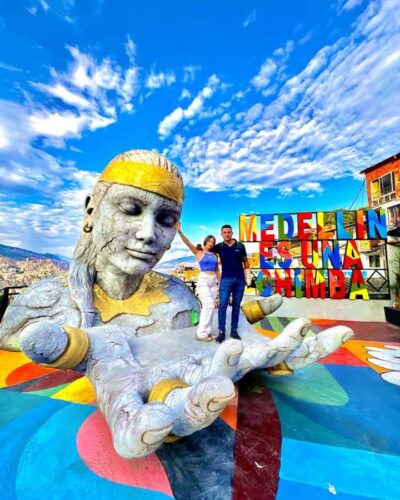
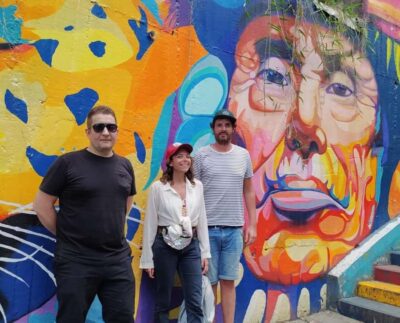
If Comuna 13 is included, it may become the most engaging part of your day. You can ride the escalators through the hillside community, see murals, look across the dense neighborhood, and hear how public investment changed daily life.
The escalators are not simply a tourist attraction. They transformed access in a steep area where movement had long been difficult. The visit becomes much more meaningful when the guide explains what life was like before the changes, how violence affected residents, and why the escalators mattered beyond convenience.
You may also hear about the community’s famous standoff and the way residents came out carrying white flags. Those details deserve more than a passing mention. Ask what happened, why the white flags mattered, and how local residents experienced the event.
Some tours bring in a local Comuna 13 guide. That can be a real benefit when the local guide is engaged and explains the neighborhood with pride. It can also create a language problem if your main guide does not translate carefully. If you do not speak Spanish, make sure the bilingual guide remains involved.
There are also commercial stops in this part of the visit. You may be offered food, hats, artwork, shirts, or other purchases. You are not required to buy anything, and these stops should not replace the historical explanation. I would politely keep the focus on the neighborhood unless you genuinely want a snack or souvenir.
Cable cars, murals, and the wider Medellín story
Some accounts also describe a ride on the city’s cable car system, which functions as public transportation across Medellín’s mountainous valley. Like the escalators, the cable car is valuable because it shows how infrastructure can connect hillside communities with the rest of the city.
The ride offers a broad look at homes, streets, and the valley below. It is not just a scenic extra. It helps you understand why transportation is central to Medellín’s social changes. In a steep city, a new route can affect access to schools, jobs, services, and public spaces.
Still, do not assume that a cable car ride is guaranteed from the short itinerary provided. Ask the operator exactly what is included on your chosen departure. The same advice applies to Comuna 13, because the listed schedule does not describe those stops in detail.
Guide quality can make or break the experience
The strongest positive reports focus on guides who are enthusiastic, proud of Medellín, and able to connect the city’s past with its present. Juan Carlos is praised for making the experience feel personal and memorable. Hector is described as energetic, city-minded, and especially effective when explaining Comuna 13 and the cable car.
The weaker experience came from a guide whose English was difficult to follow and whose narration lacked a clear chronology. Questions received short answers, and important subjects were left unexplained. That is a serious problem on a tour built around history.
You can reduce the risk by asking before departure:
- Who will guide the tour?
- How fluent is the guide’s English?
- Will Comuna 13 and the cable car be included?
- How much time will be spent at each stop?
- Can the guide explain the history in chronological order?
A private tour does not automatically mean a better guide. It does mean you have more room to speak up. If an explanation is unclear, ask for dates, names, and causes. If you want more time at a memorial or cemetery, say so early.
Is $78 per person good value?
At $78 per person, the tour is not the cheapest way to see a cemetery, memorial, or public park. You are paying for a private experience, bilingual guiding, transportation, and the convenience of combining several locations in about four hours.
For a small group, that can be worthwhile. Medellín’s hills and traffic make private transport practical, especially if you want to avoid arranging several separate rides. You also save time moving between places and can ask questions without competing with a busload of people.
The value drops if the guide provides little detail or if the tour includes only three very short stops. In that case, you may feel that you paid for a vehicle and a few photo opportunities rather than a fully explained historical experience.
I would judge the price by your priorities. Choose it if you want a private overview with transport and a guide. Skip it if you want a long, academic account of cartel history or a tour built around preserved locations. Those locations largely do not exist in the form many people expect.
Food, drinks, and personal expenses are not included. Plan to pay separately if you want anything during the outing.
Who should book this experience?
This tour suits first-time visitors who want a structured introduction to Medellín’s difficult recent past. It also fits people who have seen Narcos and want to compare television’s version with a broader account of the city.
I think it is especially useful for anyone interested in urban change. The most worthwhile material may not be the grave or former home. It may be the connection between violence, public memory, transportation, and the recovery of neighborhoods such as Comuna 13.
Families with older teenagers may find the subject compelling, but parents should remember that the tour deals with cartel violence, murder, and conflict. The private setting lets you decide how much detail is appropriate.
It is less suitable if your only goal is to collect famous crime-scene photos. The tour cannot show you several headline locations because they have been demolished, rebuilt, or sit outside Medellín.
Practical details before you go
The outing lasts about four hours, with morning and afternoon departure choices. Confirmation is provided when you book, and the tour is near public transportation. Most people can participate.
Only your group takes part, which allows for a more relaxed pace and direct questions. Private transportation is included, along with a bilingual guide and medical assistance. Food, drinks, and personal purchases are extra.
Free cancellation is available if you cancel at least 24 hours before the local start time. Cancellations or changes made within 24 hours are not refunded or accepted.
Before paying, confirm the precise itinerary. The named schedule includes Parque Memorial Inflexión, the Virgin Mary shrine, Jardines Montesacro, and Parque San Antonio. Descriptions of the experience also include Comuna 13 and the cable car, but those additions should be verified.
Should you book this Medellín tour?
Book it if you want a private, flexible introduction to Medellín’s cartel era and its recovery, especially if Comuna 13 is confirmed. The best guides, including Juan Carlos and Hector, appear to bring warmth, civic pride, and useful local perspective to the day.
Do not book it expecting a parade of untouched Escobar landmarks. Instead, expect memorials, a cemetery, short urban stops, and possibly a much stronger second half in Comuna 13.
My advice is simple: confirm the route and guide language before booking, then ask for history in clear chronological order. At $78, the experience is good value when the guide connects the difficult past to the city you see today. Without that explanation, the same stops can feel thin.
FAQ
How long is the tour?
The tour lasts approximately four hours.
How much does the tour cost?
The listed price is $78 per person.
Is the tour private?
Yes. Only your group participates in the activity.
Is transportation included?
Yes. Private transportation is included.
Is a bilingual guide included?
Yes. The tour includes a bilingual guide.
Can I choose a morning or afternoon departure?
Yes. The experience offers morning and afternoon tour options.
Are food and drinks included?
No. Food and drinks are not included unless specifically stated.
What is the cancellation policy?
You can cancel for a full refund up to 24 hours before the experience start time. Cancellations or changes made less than 24 hours before the start time are not accepted or refunded.
Just added around Medellin
- Medellin: 4-Hour Zip-Line Adventure★ 5.0 · 3 reviews
- Medellin: Tour to The Cathedral – History of Pablo Escobar and his Impact★ 5.0 · 3 reviews
- Medellin: waterfalls and naturals poolls tour★ 3.7 · 3 reviews
- Guatapé & Coffee Farm, all in one day★ 5.0 · 3 reviews
- Comuna 13: Recorrido de Arte Urbano, Cultura y Resiliencia★ 5.0 · 3 reviews
- Shared Tour Medellin’s Violence & Post-conflict after Pablo★ 4.1 · 3 reviews
- Medellin: Coffee Farm Tour & Spa with Overnight Glamping★ 4.5 · 3 reviews
- Colombia: Official Pablo Escobar Meet the Family Museum Tour★ 5.0 · 3 reviews
Medellín Tours, compared.

Comuna 13 Graffiti Tour, Cable Car & Street Food
Read our review →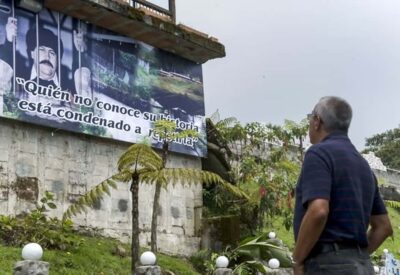
Coffee Tour with Transport, Snacks and Tastings
Read our review →
Browse the lists this tour appears in