
Reviewed · PABLO ESCOBAR TOURS
Pablo Escobar Tour in Medellin Private
Medellín’s past is hard to ignore. This private tour connects the city’s drug-trafficking history with memorials for victims, Escobar’s family grave, a neighborhood he helped build, and the house where he died. I like the victim-focused opening and the fact that private transportation keeps the outing simple. You also get time at four meaningful locations rather than rushing through a single photo stop.
The main drawback is the subject itself. A tour about Escobar can easily become too centered on the criminal, his wealth, or his legend. This experience appears to work best when you treat it as a sober look at violence, memory, and Medellín’s difficult recovery, not as a celebrity sightseeing trip.
In This Review
- Key points to know before booking
- Why this tour needs the right mindset
- Parque Memorial Inflexión puts victims first
- Jardines Montesacro and the Escobar family grave
- Barrio Pablo Escobar and the story of 250 homes
- Los Olivos and the house where Escobar died
- Private transport makes the short schedule work
- The guides can shape the experience
- Is $85 a fair price?
- Who should book this Medellín experience?
- Booking, cancellation, and practical details
- Should you book the Pablo Escobar Tour?
- FAQ
- Where does the Pablo Escobar tour take place?
- How long does the tour last?
- How much does the tour cost?
- Is this a private tour?
- Is transportation included?
- Is lunch included?
- Where is Pablo Escobar buried?
- What is Parque Memorial Inflexión?
- Can I cancel for a full refund?
- What happens if the tour does not meet its minimum number of participants?
Key points to know before booking
- Four stops in about three and a half hours: You visit Parque Memorial Inflexión, Jardines Montesacro Cemetery, Barrio Pablo Escobar, and the Los Olivos house connected to his death.
- A private experience for your group: You are not mixed into a large shared party, which gives you more control over the pace and questions.
- Victims come first: The Memorial Inflexión stop is designed around people affected by drug trafficking in the 1980s and 1990s.
- A personal connection to Escobar: You see his tomb and part of his family’s burial site at Cementerio Jardines Montesacro.
- Air-conditioned transportation included: That matters when moving between several Medellín locations during a compact afternoon or morning.
- A useful pairing with Comuna 13: One review specifically recommends combining this tour with a Comuna 13 experience, creating a fuller picture of Medellín’s past and present.
Why this tour needs the right mindset
This is not a light city tour with a few colorful anecdotes. It deals with drug trafficking, murder, fear, public memory, and the way a notorious figure still shapes how outsiders view Medellín.
I appreciate that the route begins at Parque Memorial Inflexión instead of starting with Escobar’s grave. That order matters. It places the victims and the city’s loss before the more personal and visually striking parts of the story.
You should arrive ready to listen, ask questions, and think critically. The visit to Barrio Pablo Escobar includes a mural in his honor, but that does not mean you need to accept the neighborhood’s version of his legacy uncritically. The useful question is not simply who Pablo Escobar was. It is also why some people remember his housing gifts, while others remember the terror connected to his organization.
Because this is a private activity, you can ask for clarification when a subject feels confusing or sensitive. That is a real advantage here. A fixed speech for a large group would be less helpful than a conversation adjusted to your interests and comfort level.
More narco-history tours:
- Medellín: The Real Pablo Escobar Tour
★ 4.8 · 3,205 reviews - Medellín: Pablo Escobar Tour with beer included
★ 4.7 · 612 reviews - Medellin: Guatapé Day Trip & Boat to Pablo Escobar’s Estate
★ 4.7 · 365 reviews
Parque Memorial Inflexión puts victims first
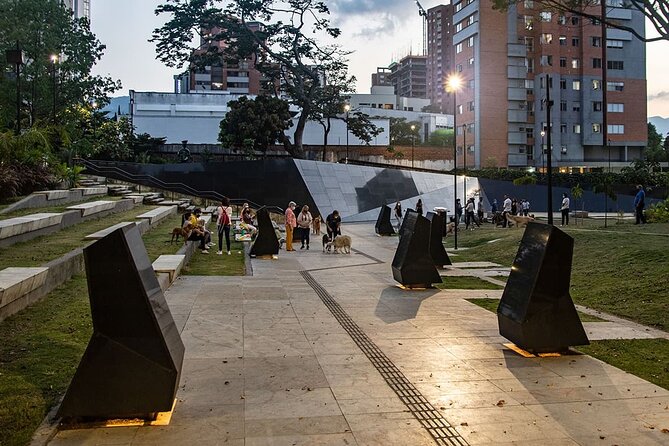
Your first stop lasts about 50 minutes at Parque Memorial Inflexión. The park is divided into three sections and was built in memory of people affected by drug trafficking during the 1980s and 1990s.
This is the most important stop for setting the moral tone of the visit. Instead of treating Medellín’s drug era as a dramatic story about one powerful man, the memorial points toward the many people who suffered because of that violence. I would give this part your full attention, even if you already know the basic facts about Escobar.
The 50-minute visit is long enough to explain the purpose of the park without making the stop feel like a quick picture break. It also gives you a chance to ask your guide how Medellín remembers that period today.
The information provided does not describe every feature of the three sections, so you should not expect a detailed architectural guide in advance. What is clear is the park’s purpose: remembrance. That makes it a stronger first stop than a visit built only around the famous criminal.
If you are looking for sensational stories, this may feel restrained. That is a good thing. The memorial asks you to think about consequences before moving on to Escobar’s grave and the places connected to his life.
Jardines Montesacro and the Escobar family grave
The second stop is Cementerio Jardines Montesacro, where you visit Pablo Escobar’s tomb and part of his family’s burial area. The planned time here is about 40 minutes, with admission included.
A cemetery changes the mood of the tour. You are no longer looking at a public memorial built for many victims. You are standing at the burial place of the man most associated with Medellín’s violent drug trade, along with members of his family.
I like the contrast between the first two stops. Parque Memorial Inflexión asks you to remember those harmed by drug trafficking. Jardines Montesacro brings you face to face with the private family side of the story. Together, the locations show why this subject remains so difficult: public grief and private mourning exist side by side.
Keep your expectations sensible. A grave is still a grave, and the visit is not likely to provide a complete biography on its own. Its value comes from the context supplied by your guide and from the shift in perspective after the memorial.
This is another reason a private format helps. If you want to ask about family connections, public memory, or the difference between myth and documented events, you can do so without holding up a large group. The guide can also help keep the conversation respectful rather than turning the stop into a spectacle.
Barrio Pablo Escobar and the story of 250 homes
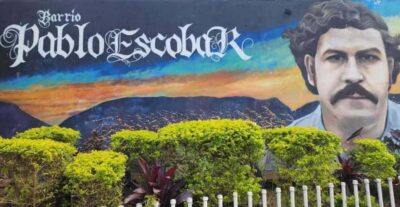
The third stop takes you to Barrio Pablo Escobar for about 50 minutes. Here, you see the neighborhood where Escobar gave away roughly 250 houses, along with a mural made in his honor.
This is probably the most complicated stop on the route. A housing project can help explain why some residents remember Escobar differently from people who suffered under his violence. It also shows how charity can be used to build loyalty, influence, or a public image.
You should not treat the donated homes as proof that Escobar was a benevolent figure. At the same time, it is worth seeing the neighborhood and understanding why his name carries more than one meaning in Medellín. A good guide should help you hold those two facts together: material help may have mattered to local families, while the wider system connected to Escobar caused immense harm.
The mural adds another layer. It is not presented as a neutral monument to the full story. It is an expression of local memory and admiration. That makes it useful, but also something you should view with care.
This stop may prompt the most questions. You can ask how the neighborhood developed, why the mural remains, and how people separate local benefits from national violence. The supplied information does not promise detailed answers to each question, so the depth may depend on the guide assigned to your group.
Still, the stop offers something a standard criminal biography cannot: a look at how power operates in a real neighborhood. Escobar is remembered here not only through crime statistics or television dramas, but through houses, streets, and a public image that some people still defend.
A few more trips worth weighing up before you book
- Medellin: Comuna 13 Graffiti Tour, Cable Car & Street Food
★ 4.8 · 9,046 reviews - Medellín: Comuna 13 True Story and Street Food Tour
★ 4.9 · 1,779 reviews - Medellín: Comuna 13 District Tour with Cable Car Ride
★ 4.8 · 1,467 reviews - Medellin: Coffee Tour with Transport, Snacks and Tastings
★ 4.7 · 1,357 reviews
Los Olivos and the house where Escobar died
The final stop lasts about one hour in Medellín’s Los Olivos neighborhood. You visit the house where Pablo Escobar died, specifically the roof of a house connected to the event.
This is the tour’s most dramatic location, and it is easy to see why. After beginning with a memorial for victims, visiting the family grave, and seeing the neighborhood tied to Escobar’s charitable image, you end at the place associated with his death.
The hour-long visit allows time for explanation rather than a quick stop outside a building. The information provided does not say that the house is a museum or that there is a formal interior exhibit. You should therefore think of this as a site visit, not a polished attraction with displays and facilities.
That distinction matters. The power of the stop comes from location and context. You are seeing the roof of a private house in Los Olivos, not entering a purpose-built museum about the drug trade. The experience may feel plain physically, but the story attached to it is significant.
I would avoid treating the final stop as a victory lap for Escobar. His death is part of Medellín’s history, but the tour is stronger when it connects that moment to the people and communities affected by the violence. The route works best as a study of cause, consequence, memory, and myth.
Private transport makes the short schedule work
The tour lasts about three hours and 30 minutes. Private transportation in an air-conditioned vehicle is included, which is useful because the stops are spread across different parts of Medellín.
With four stops, the timing is fairly tight. The listed visits add up to about three hours and 20 minutes, leaving only a small amount of time for driving and transitions within the approximate total. You should expect an efficient route rather than long, unplanned breaks.
The private vehicle also removes some of the day’s friction. You do not need to organize separate rides between a memorial, cemetery, neighborhood, and residential area. For a group that wants a focused introduction to this subject, that convenience adds real value.
Because the vehicle is air-conditioned, you have a more comfortable base between stops. Lunch is not included, so plan to eat before or after the experience. The tour is not presented as a food outing, and its schedule does not appear to allow for a full meal.
The private format is especially useful for two people, a family, or a small group with a shared interest in Medellín’s recent past. You can ask more questions and maintain a pace that suits your group. If your party is quiet, the guide can explain without competing with unrelated conversations.
The guides can shape the experience
Guide quality matters a great deal on a tour like this. The most positive comments single out Julian for being personable and well informed, while Sofia is praised for patience and for making sure the experience suited the group.
Those details point to the qualities you should value here. You want a guide who can explain the violence clearly, avoid glamorizing Escobar, and handle different local memories without flattening the story into a simple good-versus-evil script.
Sofia’s patient approach sounds particularly useful for a private visit. A slower explanation can help when the subject includes complicated political, social, and personal details. Julian’s personable style suggests a more conversational experience, which may suit you if you prefer asking questions rather than listening to a long lecture.
The guide’s actual style can vary, so I would use the private setting well. Tell your guide what you already know, ask for context, and say if you want more focus on victims, urban change, family history, or the timeline of events.
The tour received a five-star rating from 47 reviews, with 100 percent recommending it. That is a strong signal for satisfaction, especially since the praise focuses on the experience being informative, patient, and eye-opening rather than only on transport or convenience.
Is $85 a fair price?
At $85 per person, the price is not the cheapest way to see a few Medellín locations. But the value improves when you count what is included: a private activity, private transportation, an air-conditioned vehicle, admission to the first three listed sites, and about three and a half hours of guided time.
You are paying for organization and context as much as for entry. Without a guide, you could perhaps arrange visits to some locations yourself, but you would have to manage transport and piece together the meaning of each stop. On this subject, the explanation is the main product.
The price is easier to justify for a small group. If you are traveling with friends or family, the private vehicle and shared guide attention may feel worthwhile. For a solo visitor, $85 is a larger outlay, so you should book only if this subject is a priority.
Lunch is extra, and the tour does not include any stated additional meal or personal expense. Keep that in mind when planning the rest of your day.
Who should book this Medellín experience?
I would recommend this tour to you if you want a focused introduction to the Escobar era and prefer a private setting. It suits people who want to connect famous locations with Medellín’s victims, neighborhoods, and public memory.
It is also a good choice if you value a guide-led conversation. The reviews point to strong praise for Julian’s personable approach and Sofia’s patience, two traits that can make a difficult topic easier to understand.
You may want to skip it if you are seeking a broad overview of Medellín beyond Escobar, or if you dislike tours centered on criminal figures. The route does show a victim memorial and a real neighborhood, but its central subject remains Pablo Escobar.
You can pair it with a Comuna 13 tour, as one review specifically suggests. That combination would let you compare a neighborhood associated with violence and public controversy with a community known for another chapter of Medellín’s transformation. The two experiences together may give you a wider view of the city than this tour alone.
Booking, cancellation, and practical details
Confirmation is provided when you book. The activity is private, so only your group participates, and most people can take part according to the supplied information.
Free cancellation is available if you cancel at least 24 hours before the experience starts. Cancellations or changes made less than 24 hours before the local start time are not accepted for a refund. The experience also requires a minimum number of participants, and if that minimum is not met, you can be offered another date or experience, or receive a full refund.
The tour is booked, on average, 24 days in advance. That does not guarantee that every date fills early, but it is a useful hint to avoid waiting until the last minute if your Medellín schedule is fixed.
Should you book the Pablo Escobar Tour?
Book it if you want a private, direct, and serious look at Medellín’s drug-trafficking past, with the route anchored by a victims’ memorial rather than only by Escobar’s fame. The four stops give you several angles: public mourning, family burial, neighborhood influence, and the site of his death.
The $85 price makes the most sense for a small group that values a private vehicle and a guide who can explain difficult material patiently. I would pair it with Comuna 13 if you have room in your schedule.
Skip it if your interest is mainly in modern Medellín, food, art, or everyday city life. This tour is narrow by design, but within that subject it offers a useful balance of remembrance, place, and uncomfortable questions.
FAQ
Where does the Pablo Escobar tour take place?
The tour takes place in Medellín, Colombia, with stops at Parque Memorial Inflexión, Cementerio Jardines Montesacro, Barrio Pablo Escobar, and the Los Olivos neighborhood.
How long does the tour last?
The experience lasts approximately three hours and 30 minutes.
How much does the tour cost?
The listed price is $85 per person.
Is this a private tour?
Yes. Only your group participates in the private activity.
Is transportation included?
Yes. Private transportation in an air-conditioned vehicle is included.
Is lunch included?
No. Lunch is not included in the tour price.
Where is Pablo Escobar buried?
His tomb is at Cementerio Jardines Montesacro, where you also visit part of his family’s burial area.
What is Parque Memorial Inflexión?
It is a memorial park divided into three sections and built in memory of people affected by drug trafficking in the 1980s and 1990s.
Can I cancel for a full refund?
Yes, if you cancel at least 24 hours before the experience start time. Cancellations made less than 24 hours in advance are not refunded.
What happens if the tour does not meet its minimum number of participants?
You will be offered a different date or experience, or a full refund if the activity is canceled because the minimum is not met.
Just added around Medellin
- Medellin: 4-Hour Zip-Line Adventure★ 5.0 · 3 reviews
- Medellin: Tour to The Cathedral – History of Pablo Escobar and his Impact★ 5.0 · 3 reviews
- Medellin: waterfalls and naturals poolls tour★ 3.7 · 3 reviews
- Guatapé & Coffee Farm, all in one day★ 5.0 · 3 reviews
- Comuna 13: Recorrido de Arte Urbano, Cultura y Resiliencia★ 5.0 · 3 reviews
- Shared Tour Medellin’s Violence & Post-conflict after Pablo★ 4.1 · 3 reviews
- Medellin: Coffee Farm Tour & Spa with Overnight Glamping★ 4.5 · 3 reviews
- Colombia: Official Pablo Escobar Meet the Family Museum Tour★ 5.0 · 3 reviews
Pablo Escobar Tours, compared.

Guatapé Day Trip & Boat to Pablo Escobar’s Estate
Read our review →

(Private Guatapé) Mansion Pablo Escobar+Paintball+Cuatrimoto+Boat
Read our review →Browse the lists this tour appears in