
Reviewed · CARTAGENA TOURS
Shared Getsemani Art District Tour with Wireless Live System
Getsemaní tells Cartagena’s story in color. This $9 walking tour links Centenario Park, Trinidad Square, street art, Afro resistance, and a San Felipe Fortress viewpoint into a lively 2.5-hour introduction to one of Cartagena’s most distinctive neighborhoods. I like the wireless audio system, which lets you hear the guide without standing shoulder to shoulder, and I like the focus on local people, art, and independence rather than only colonial buildings. The main drawback is the pace: you walk about 8 kilometers in hot weather, so this is not a gentle stroll.
I also appreciate the chance to sample a homemade corozo drink and receive local restaurant, coffee, and souvenir tips at the end. The tour is shared, not private, so group size and the amount of personal attention can vary. Still, for the price, it offers a useful way to understand why Getsemaní feels like more than a photogenic corner of Cartagena.
In This Review
- Key points at a glance
- Why Getsemaní deserves more than a quick photo stop
- Starting at the Plaza de la Proclamación
- Centenario Park and Cartagena’s independence
- Trinidad Square and Getsemaní after dark
- Graffiti, narrow streets, and the language of resistance
- The Well Square and everyday neighborhood character
- San Felipe Fortress viewpoint and stories of battle
- What the wireless system changes
- Is $9 a fair price?
- Comfort, distance, and who should book
- Should you book the Getsemaní Art District Tour?
- FAQ
- How long does the Getsemaní Art District Tour last?
- What languages are available?
- Where does the tour meet on weekdays?
- Where does the tour meet on weekends?
- Does the tour include transportation?
- How far do you walk?
- Can I cancel for a refund?
Key points at a glance
- Wireless audio keeps the stories clear: You receive a headset system, so you can hear the guide while taking photos or walking a little apart from the group.
- Getsemaní’s resistance is central: The tour explains Afro uprising, segregation during the colonial period, and the neighborhood’s role in Cartagena’s independence.
- Trinidad Square changes after dark: You learn why this square became a center for artistic and cultural activity, especially at night.
- Street art is treated as history: Graffiti, narrow streets, and painted walls are presented as ways to express identity and resistance.
- The walk covers about 8 kilometers: Comfortable shoes, water, a hat, and sunscreen are not optional extras here.
- The price is hard to beat: At $9 per person, you get a guide, audio equipment, a local drink, neighborhood sightseeing, and practical recommendations.
Why Getsemaní deserves more than a quick photo stop
Many people first notice Getsemaní through its painted walls, decorated streets, music, and busy squares. Those details are attractive, but they only make sense once you understand the neighborhood’s past. This tour gives you that background while walking through the places where the story is still visible.
The central idea is resistance. Getsemaní was shaped by people who lived apart from Cartagena’s colonial power structure and fought against exclusion. The tour connects that Afro uprising to the independence of Cartagena, then follows the same fighting spirit into modern art, dance, music, painting, sculpture, and film.
That connection is useful because it changes how you read the neighborhood. A mural is not just a colorful backdrop. A narrow street is not merely a pretty place for a photograph. The streets, walls, and public squares become signs of memory, pride, and community life.
The tour is offered in English or Spanish. A live guide leads the walk, while the wireless system carries the commentary to you. That combination is particularly helpful in Getsemaní, where traffic, music, conversation, and crowds can easily swallow a guide’s voice.
A few more trips worth weighing up before you book
- Cartagena: Historic Center and Getsemaní Shared Walking Tour
★ 4.9 · 2,716 reviews - Cartagena: Rosario Islands Catamaran with Lunch and Snorkel
★ 4.5 · 2,479 reviews - Full-Day Rosario Islands Including Barú, Bocachica & Playa Blanca
★ 4.0 · 1,729 reviews
Starting at the Plaza de la Proclamación
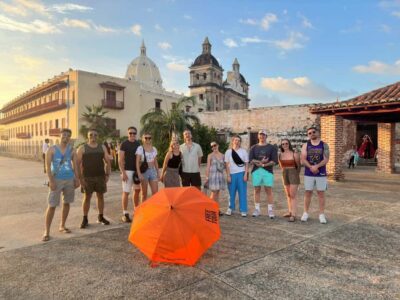
From Monday through Friday, the meeting point is the Plaza de la Proclamación, beside the statue of the Pope. Look for the red Beyond Colombia umbrellas and arrive about five minutes early. That early arrival matters because you need time to receive the wireless audio equipment, and the group moves two blocks to the actual departure point.
On Saturdays and Sundays, the meeting point is Plaza de Santo Domingo, beside Botero’s large statue of Gertrudis. The weekend location is different, so check your reservation carefully before leaving your hotel. Arriving at the wrong square could mean a sweaty and unnecessary rush through the old city.
These plazas help set the stage for Cartagena. You begin among major public spaces before moving into the more intimate streets of Getsemaní. The transition is part of the experience: the tour shifts from grand civic memory to neighborhood stories, murals, local traditions, and everyday life.
There is no hotel pickup and no vehicle involved. You walk from start to finish, with resting stops along the way. That keeps the price low and lets you see the area at street level, but it also means you should plan your clothing and water supply sensibly.
Centenario Park and Cartagena’s independence
Centenario Park is one of the key early stops. Its importance comes from its connection to the commemoration of Cartagena’s independence. Here, the guide places Getsemaní within the larger story of the city rather than treating it as an isolated arts district.
This is where the tour’s historical purpose becomes clear. Getsemaní’s role was not simply decorative or social. Its people were tied to the political and social forces that helped push Cartagena toward independence. The explanation focuses on the people behind the event, especially the Afro communities whose resistance helped shape the city.
I find this approach more useful than a simple list of dates. You are encouraged to see independence as something built through conflict, inequality, and collective action. The park provides a public setting for that discussion, then the walk carries the subject into the neighborhood where those tensions remain part of the identity.
Centenario Park also offers a natural pause early in the walk. You can listen, look around, and adjust to the heat before the longer sections through the streets. Do not expect a long formal stop with a seat for everyone, though. This remains an active walking tour.
Trinidad Square and Getsemaní after dark
Trinidad Square is the social heart of the tour. The square is linked to Getsemaní’s artistic movement and its nighttime culture, when public space fills with music, conversation, and informal activity.
The guide explains how this cultural life grew from the neighborhood’s older traditions and its history of resistance. That is important context. You are not simply being shown a popular place to gather. You are seeing how a square can become a stage for local expression.
The timing of your tour affects the feel of this stop. The activity at night is part of the story, but the tour itself lasts 2.5 hours and starting times vary. Check availability if experiencing the nighttime atmosphere is important to you. A daytime departure may offer clearer views of walls and architecture, while an evening departure may better match the square’s cultural character.
The shared format works well here because there is usually plenty to look at while the guide talks. With the headset, you can step slightly aside for a photograph and still follow the explanation. That freedom is one of the best practical features of the tour.
The tradeoff is that a public square can be crowded and noisy. Keep your belongings close. The tour specifically warns you not to let your guard down in crowded places, and that is sound advice in any busy part of Cartagena.
A completely different kind of day out around Cartagena:
- Cartagena de Indias: 2-Hour Sunset Cruise
★ 4.7 · 1,105 reviews - 2-hour tour in Cartagena Sunset View in party boat
★ 4.6 · 899 reviews - Cartagena: Guided Street Food Tour with Tastings
★ 4.9 · 833 reviews - Cartagena: City Sightseeing Hop-On Hop-Off Bus Tour & Extras
★ 3.9 · 681 reviews
Graffiti, narrow streets, and the language of resistance
The street art section gives the tour its strongest visual appeal. Getsemaní’s graffiti is explained as a form of resistance, not simply decoration. The walls carry ideas about identity, memory, pride, and the neighborhood’s continuing voice.
The tour also points out the contrast between wide and narrow streets. These spaces represent different parts of Getsemaní’s traditions and history. The point is not only to admire the artwork, but to understand how the shape of the neighborhood affects the way people move, gather, and tell their stories.
You will have time to take photos, but remember that this is not a dedicated photography walk. The guide continues moving, and the group has a fixed route. The wireless system helps you pause briefly without losing the commentary, though you still need to keep up.
I would bring a camera, but I would also leave room for observation. The best part of the art is the connection between the image and the place. If you rush from mural to mural, you may miss the explanation of why graffiti matters here.
The art changes over time, while the underlying themes remain. This makes the tour useful even if you have already seen photographs of Getsemaní. You gain a framework for looking at the walls rather than simply collecting pictures of them.
The Well Square and everyday neighborhood character
The Well Square is another stop tied to local identity. The tour uses the square to explore stories and legends that are less visible at first glance. This is one reason the walk is more than a route between famous points.
The neighborhood is now popular with visitors, but it still has residents whose families are connected to its older culture. The tour tries to keep those people in the story. You may hear about traditions that survive through music, dance, public gatherings, and local customs rather than through monuments.
One particularly appealing part of the experience is the possibility of speaking with older local residents. That kind of contact can make the history feel personal, though it depends on the moment and should never be treated as a guaranteed performance. The tour is strongest when it lets the neighborhood speak for itself.
You also receive a courtesy shot of homemade corozo, a local fruit drink. It is a small touch, but a good one. Food and drink can provide a direct link to place, and this tasting adds a local flavor without turning the tour into a restaurant crawl.
San Felipe Fortress viewpoint and stories of battle
The walk ends with a viewpoint toward San Felipe Fortress. The fortress brings the story back to warfare, battles, and victories. After learning about resistance in the streets, you get a wider view of the defenses that helped protect Cartagena.
The viewpoint is not the same as a full fortress visit. No entrance ticket is included, and the tour does not take you inside places where extra charges suddenly appear. That is helpful for budgeting, but you should not book this experience expecting a detailed exploration of San Felipe’s tunnels or interior passages.
Instead, the stop works as a visual ending. From the viewpoint, the guide can connect Getsemaní’s people and independence movement with the military history of Cartagena. The neighborhood story expands beyond murals and squares to include the city’s larger battles.
This is also a practical point in the walk. By the time you reach it, you may have covered close to 8 kilometers. If your feet are tired, the viewpoint may feel like a welcome final chapter rather than another major attraction to explore.
The activity finishes back at the meeting point. Since you return to where you began, it is easy to continue exploring the old city, find a meal, or use the provider’s recommendations for coffee, lunch, souvenirs, and other local businesses.
What the wireless system changes
A wireless audio system may sound like a small upgrade, but it matters on a walking tour. You do not need to crowd around the guide every time the group stops. You can hear while looking at a mural, taking a picture, or standing a few steps away from the main cluster.
This setup also reduces the usual frustration of city tours. Cartagena has traffic, voices, music, and other groups. Without amplification, important details can disappear. Here, the equipment gives you a better chance of catching names, explanations, and historical links.
The system does not make the tour private. You still share the guide with other people, and the pace remains that of a group walk. It simply gives you more freedom inside the group.
Arrive five minutes early to collect the equipment. If you arrive at the last moment, you may delay the start or miss the first instructions. At the end, return the equipment as directed and keep the wristband provided by the company if you want to use its partner discounts.
Is $9 a fair price?
Yes, provided you want a walking introduction rather than a private deep historical study. For $9, you receive a live English or Spanish-speaking guide, wireless audio, a walk through major Getsemaní sights, a corozo tasting, and recommendations for local places to eat, drink coffee, and shop.
You do not pay for transportation, food beyond the courtesy drink, souvenirs, or entry tickets. That keeps the cost clear. You should budget separately for anything you buy during or after the walk.
The value is strongest for a first visit. In 2.5 hours, you get a working map of the neighborhood and a story that links its public spaces, art, people, and independence. If you already know Getsemaní well, the price is still modest, but you may prefer a more specialized art or history experience.
The tour is shared, so do not expect an exclusive guide or a custom route. For many people, that is part of the appeal. You may meet other people while seeing the area, but you will have less control over stops and pace.
Comfort, distance, and who should book
Wear comfortable walking shoes. The stated distance is about 8 kilometers, with pauses to listen to the guide, so sandals that offer little support may become uncomfortable. Bring water or another preferred drink, sunscreen, a hat, and clothes that feel good in warm weather.
This is not suitable for wheelchair users or people with mobility impairments. The distance, street conditions, and walking format make that restriction important. If you have trouble walking several kilometers, choose a shorter or vehicle-based way to see Getsemaní.
I would recommend the tour to first-time visitors who want context before exploring the neighborhood alone. It also suits people interested in Afro history, independence, public art, music, and local culture more than formal architecture.
It is less suitable if you dislike walking in heat, want a quiet private tour, or plan to spend most of your time inside historic buildings. There are resting stops, but this is still a long outdoor walk.
Should you book the Getsemaní Art District Tour?
Book it if you want an affordable introduction to the neighborhood’s resistance, art, and public life. The strongest features are the clear wireless audio, the focus on Afro history and local culture, and the way the route ties ordinary streets to Cartagena’s independence.
Skip it if 8 kilometers sounds excessive, if you need step-free access, or if your main goal is to tour San Felipe Fortress itself. For most first-time visitors who can handle the distance, $9 is a sensible buy. Bring water, arrive early at the correct weekend or weekday meeting point, and leave space in your schedule for the neighborhood to keep talking after the tour ends.
FAQ
How long does the Getsemaní Art District Tour last?
The tour lasts 2.5 hours. Starting times vary, so check availability when choosing your date.
What languages are available?
The live tour guide and audio system are available in English and Spanish.
Where does the tour meet on weekdays?
From Monday through Friday, meet in Plaza de la Proclamación beside the Pope statue. Look for the red Beyond Colombia umbrellas.
Where does the tour meet on weekends?
On Saturdays and Sundays, meet in Plaza de Santo Domingo beside Botero’s statue, Gertrudis.
Does the tour include transportation?
No. The tour is entirely on foot and includes resting stops along the way.
How far do you walk?
You walk about 8 kilometers during the experience, with stops to listen to the guide.
Can I cancel for a refund?
Yes. You can cancel up to 24 hours in advance for a full refund. You can also reserve now and pay later.
Just added around Cartagena
- Cartagena: Ecoplan on Barú, Aviary and Oceanarium in one day★ 3.3 · 3 reviews
- Isla Tierra Bomba beach club: Day Pass with typical food★ 5.0 · 3 reviews
- Cartagena: Party Bus Tour In Cartagena★ 4.2 · 3 reviews
- White Night Boat Party: Dinner Buffet, Dancing and Open Bar★ 4.6 · 3 reviews
- Tayrona Park adventure in Santa Marta: Cabo San Juan from Cartagena★ 3.8 · 3 reviews
- Mompox Caribbean Routes★ 4.8 · 3 reviews
- Cartagena: Photography Workshop Tour★ 5.0 · 3 reviews
- Cartagena: Day Tour to Tierra Bomba Island★ 3.2 · 3 reviews
Cartagena Tours, compared.
Historic Center and Getsemaní Shared Walking Tour
Read our review →
Rosario Islands Catamaran with Lunch and Snorkel
Read our review →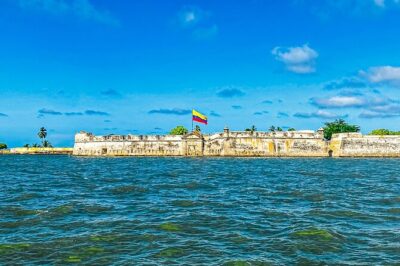
Full-Day Rosario Islands Including Barú, Bocachica & Playa Blanca
Read our review →

2-hour tour in Cartagena Sunset View in party boat
Read our review →

City Sightseeing Hop-On Hop-Off Bus Tour & Extras
Read our review →
Browse the lists this tour appears in