
Reviewed · COMUNA 13 & STREET ART TOURS
Bogotá: La Candelaria Graffiti & Urban Art Guided Tour
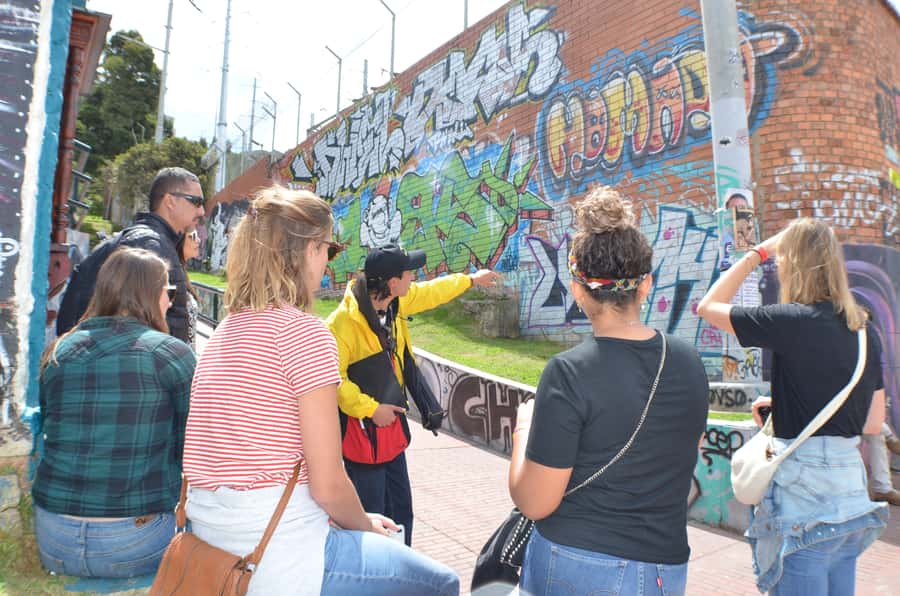
Street art gives Bogotá a second voice. This 150-minute walk through La Candelaria connects bold murals with Colombia’s politics, Indigenous identity, and changing downtown culture. I especially like the small groups of up to 10 people, which make it easier to ask questions, and the stop at Café Herencia for coca leaf tea, a simple local touch that gives the walk a pleasant finish.
I also like that the tour goes beyond the biggest, most photographed walls. Guides point out artists such as 3 Manos, Ledania, Bastardilla, Vera, Carlos Trilleras, Wosnan, and Ocio 4, explaining how their work reflects social issues and personal identity. The main drawback is that the tour may be conducted in English and Spanish at the same time, depending on the group. That can slow the pace of the explanations.
In This Review
- Key things to know before you go
- Why La Candelaria is the right place for street art
- Chorro de Quevedo: starting among old streets and new ideas
- The first hour: reading murals instead of merely photographing them
- La Concordia Market: a living meeting point
- Journalist’s Park and the public life of downtown
- Returning through La Candelaria with a better eye
- Café Herencia and the coca leaf tea finish
- What the $16 price really buys you
- The bilingual format and other practical limits
- Who will enjoy this tour most
- Should you book the La Candelaria graffiti tour?
- FAQ
- Where does the Bogotá graffiti tour begin?
- What time does the tour start?
- How long does the tour last?
- Is transportation included?
- Which languages are available?
- What is included in the price?
- Can I cancel the booking?
Key things to know before you go
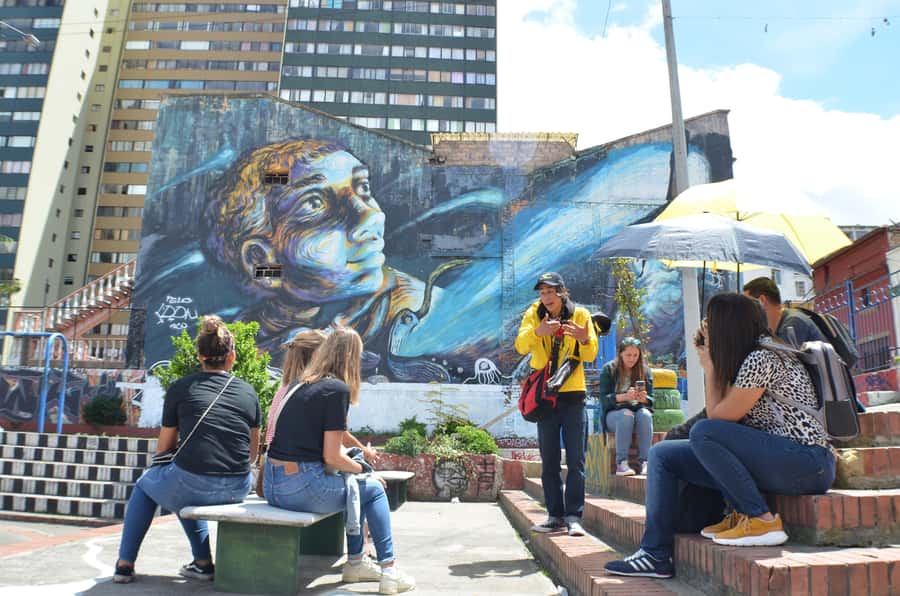
- The walk begins at Chorro de Quevedo: Meet beside the fountain under the yellow umbrella at 10am or 2pm.
- The art comes with context: Your guide explains tags, murals, symbolism, Indigenous themes, current issues, and the politics behind Bogotá’s graffiti scene.
- You visit La Concordia Market and Journalist’s Park: These are useful stops for understanding how people and ideas gather in central Bogotá.
- The route includes women artists: Bastardilla, Vera, and Ledania receive attention in a scene often presented as male dominated.
- Coca tea ends the outing: The final stop is Café Herencia, a coffee shop that supports local artists.
- Bring practical walking gear: Comfortable shoes, water, sunscreen, a camera, and clothing suited to changing weather are sensible choices.
Why La Candelaria is the right place for street art
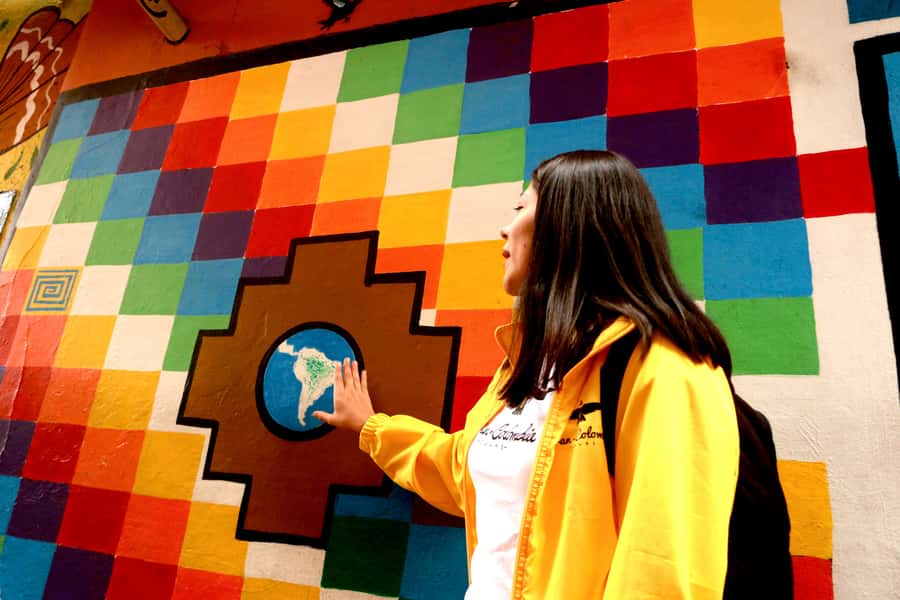
La Candelaria is Bogotá’s old central district, but this tour does not treat it as a simple collection of colonial buildings. Its narrow streets and public squares also form a record of political arguments, cultural memory, and artistic experimentation.
You begin in Plazoleta del Chorro de Quevedo, a well-known meeting point in the district. From there, the guide leads you through streets covered with murals, tags, and spray-painted works. The important part is not just seeing a wall. It is learning why a particular image appears there, what symbols it uses, and how different forms of street art relate to one another.
Your guide introduces the difference between quick tags, larger graffiti pieces, and murals that may take much more planning. That distinction helps you look more closely. Instead of seeing a wall as one colorful mass, you start noticing lettering, figures, layers, styles, and the marks left by different artists.
The tour also explains why Bogotá has become important in the international street-art scene. The focus is local rather than flashy. You hear about Colombian artists and the way they use public walls to talk about ancestry, inequality, politics, the environment, and the city itself.
More Comuna 13 and street art walks:
- Fun Graffiti Workshop: The Art of Aerosol and Color
★ 5.0 · 73 reviews - Graffiti Tour in La Candelaria Bogotá with Transportation
★ 5.0 · 68 reviews - Bogotá: Graffiti Tour el mejor recorrido de arte urbano
★ 4.7 · 41 reviews
Chorro de Quevedo: starting among old streets and new ideas
The meeting point at Chorro de Quevedo is practical because it places you directly inside La Candelaria. Look for the fountain and the yellow umbrella. The operator runs departures every day at 10am and 2pm, giving you an easy choice between a morning walk and an afternoon outing.
The square is more than a place to gather. It is one of the district’s social meeting points, and the tour uses that setting to introduce Bogotá’s habit of bringing different ideas together in public spaces. From the start, you are walking through an area where history, student life, art, and local commerce overlap.
This is a walking tour, not a bus excursion with distant views. You will spend most of the 150 minutes on foot, stopping often while the guide explains a piece. Wear shoes that can handle uneven city sidewalks, and bring water. Bogotá’s weather can change, so the included umbrella is useful if rain arrives.
The first hour: reading murals instead of merely photographing them
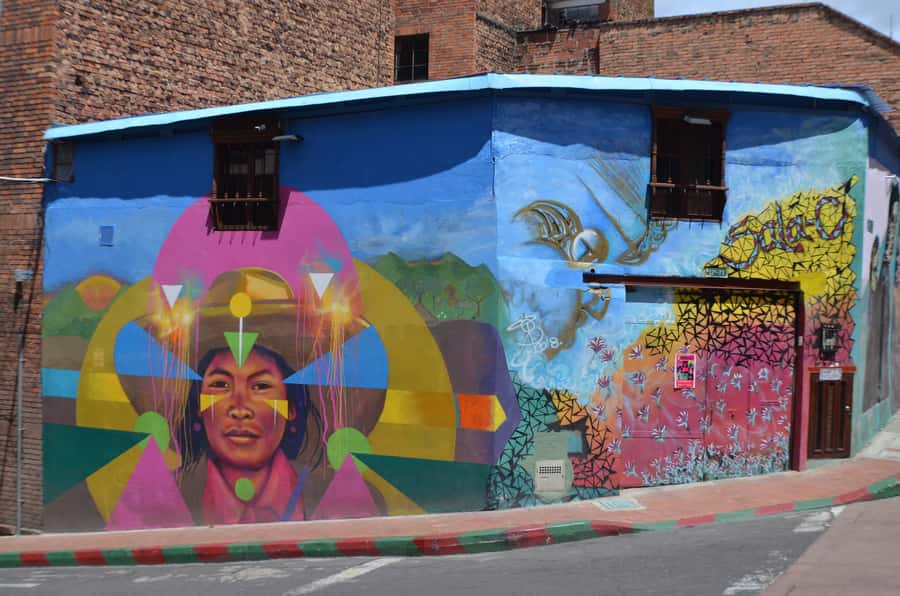
The main section through La Candelaria lasts about an hour. This is where the tour earns its price. You see a steady series of graffiti works, but the guide gives each stop a reason for being there.
Artists including Carlos Trilleras, Wosnan, Ocio 4, and 3 Manos are part of the discussion. The exact works you see can change as walls are painted over, weathered, or altered. That is part of the nature of public art, and it also makes a guide valuable. Someone familiar with the area can direct your attention to pieces you could easily miss while walking alone.
The explanations connect visual details to Colombian society. Indigenous ancestry is a recurring subject, especially in work that links identity with the city. You may also hear about environmental concerns and current social questions. The result is not an art lecture removed from daily life. The murals are treated as public statements made in public places.
One useful feature is the discussion of women artists. Bastardilla, Vera, and Ledania are included, giving you a fuller picture of Bogotá’s art scene. Their presence matters because it shows that the city’s graffiti culture is not only a story of male crews and political tags. The guide explains how women have helped shape and spread the form.
Several guide names appear repeatedly in the tour’s recent operation, including Juana, Luis, Christian, Lorena, Bernardo, Myra, Ivonne, and José. The guide assigned to you will vary, but the strongest descriptions point to friendly explanations, good English or Spanish, and plenty of time for questions. One particularly useful feature reported by past participants was a guide showing short supplemental videos about the making of certain murals. That is not listed as a guaranteed part of every departure, so treat it as a possible bonus rather than a promise.
La Concordia Market: a living meeting point
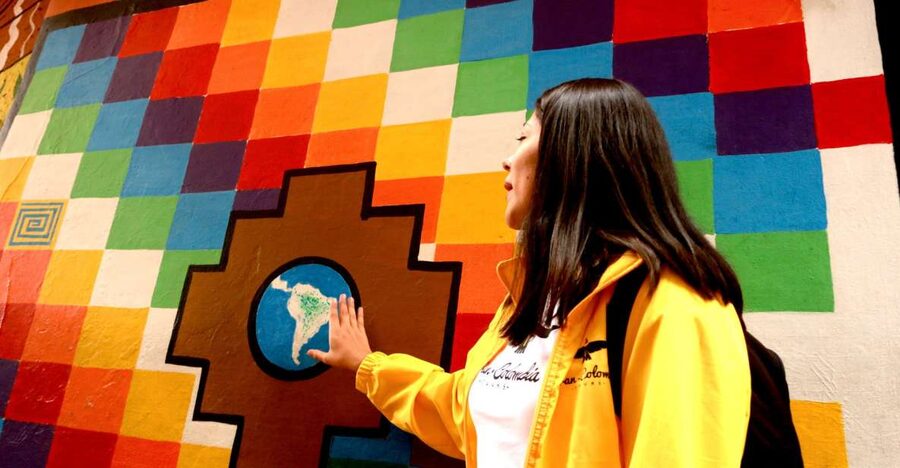
The route then spends about 15 minutes around La Concordia Market. This is a shorter stop, but it gives the art a useful setting.
The market is described as a meeting point where ideas and influences come together. That helps explain why street art flourishes around central Bogotá. Art does not appear in a vacuum here. It shares space with food, shopping, conversation, and the ordinary movement of city life.
You should not expect a long market visit or a dedicated food tour. The stop is mainly about place and context, with some time to look around. If you want to browse carefully, you may need to return on your own later. Still, the brief pause breaks up the walk and shows you a part of La Candelaria beyond its painted walls.
More La Candelaria wanders:
- Bogotá: Guided La Candelaria Walking Tour
★ 4.8 · 1,229 reviews - Shared Tour of Bogota’s Historic Downtown (La Candelaria)
★ 4.7 · 100 reviews - VIP Bogota City Tour: Farmers Market, Monserrate, Candelaria, 9hr
★ 5.0 · 66 reviews - Food Tour in La Candelaria Bogotá
★ 5.0 · 63 reviews
Journalist’s Park and the public life of downtown
The tour spends roughly an hour around Journalist’s Park, making it one of the more substantial sections of the route. Like Chorro de Quevedo and La Concordia, this area is presented as a place where people meet and exchange ideas.
That detail is important for understanding the murals. Public squares and central streets are not just backdrops. They help determine who sees the art and how it enters public conversation. Your guide uses the area to connect Bogotá’s downtown identity with the messages painted on its walls.
This is also a good point to ask questions. The tour works best when you treat it as a conversation rather than a photo stop. Ask your guide about a symbol you do not recognize, why one work has a particular style, or how a tag differs from a mural. Past participants have praised guides for inviting questions and keeping explanations patient, even when the group was very small.
The group limit is 10 people, although the outing may sometimes have only two participants or even operate as a private tour. That creates a more personal experience, but it also means the pace can depend on how many questions people ask. If the tour is bilingual, explanations may take longer.
Returning through La Candelaria with a better eye
The final 30-minute section returns through La Candelaria and includes a photo stop. By this point, you will likely see the neighborhood differently.
At first glance, graffiti can look like decoration. After the guide explains the artists and themes, small details begin to carry more weight. You may notice Indigenous references, political imagery, environmental ideas, and the difference between a quick personal mark and a carefully planned mural.
This final stretch is useful because it gives you time to take photographs without rushing through every explanation. Bring a camera, but remember that these works are temporary. Sun, rain, new paint, and changing city policies can alter a wall. Photos become a record of what you saw on that particular day.
The route returns to Chorro de Quevedo, so you finish where you started. That makes it easy to continue exploring La Candelaria, stop for food, or visit another nearby attraction afterward.
Café Herencia and the coca leaf tea finish
The tour ends at Café Herencia, a coffee shop that works with and supports local artists. You taste coca leaf tea and have a chance to settle after the walk.
Coca tea is not included as a gimmick detached from the tour. It fits the wider focus on Colombian culture and local traditions. The stop also gives the experience a sense of place. Rather than ending abruptly on a street corner, the group finishes in a café connected to the arts community.
The tea itself may be unfamiliar to you, and the guide can provide useful cultural context. Do not expect a full meal or an extended café visit. It is a tasting, not a restaurant stop. If you want more food, plan to eat before or after the tour.
Some past participants also described the café as having murals and an artistic atmosphere. That makes it a fitting final stop, though the main value remains the tea and the connection to local artists.
What the $16 price really buys you
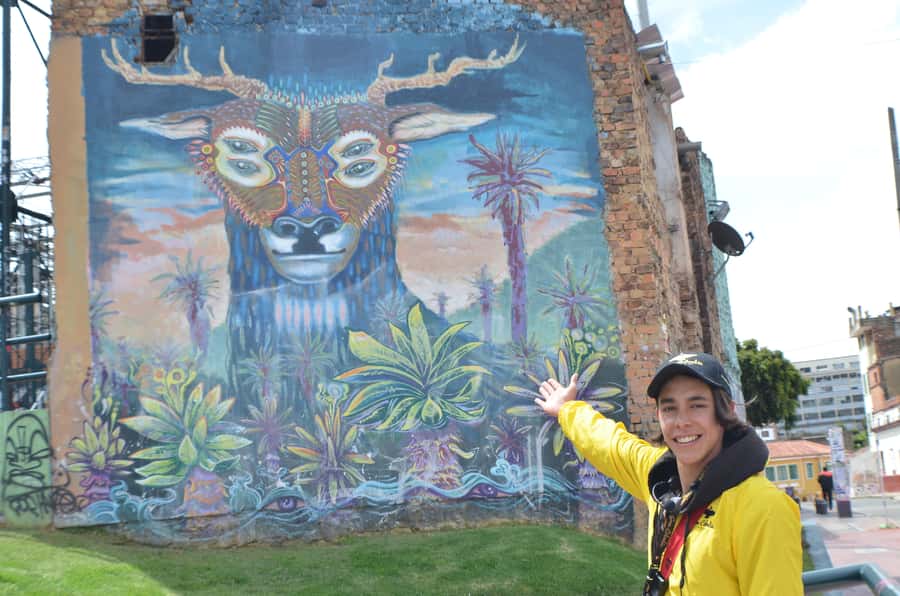
At $16 per person, this is good value if you want to understand what you are seeing rather than simply walk past it. The price includes the Gran Colombia Tours guide, the street-art interpretation, the coca tea, all-risk insurance, and an umbrella in case of rain.
Transportation is not included, but that is not a serious weakness here. The experience is designed as a central walking route, and adding a vehicle would remove much of the point. You need to reach Chorro de Quevedo on your own and return from there at the end.
The value comes from access to local explanation. You can walk through La Candelaria without paying anything, but you will not necessarily know the artists, the social background, or the meaning of recurring images. A guide also helps you find works tucked along streets that are easy to pass without noticing.
The small group limit adds value too. A group of 10 is large enough to create conversation but small enough for questions. If only a few people book, the tour may continue with that small group. That has happened before, and it can turn the walk into something close to a private outing.
The bilingual format and other practical limits
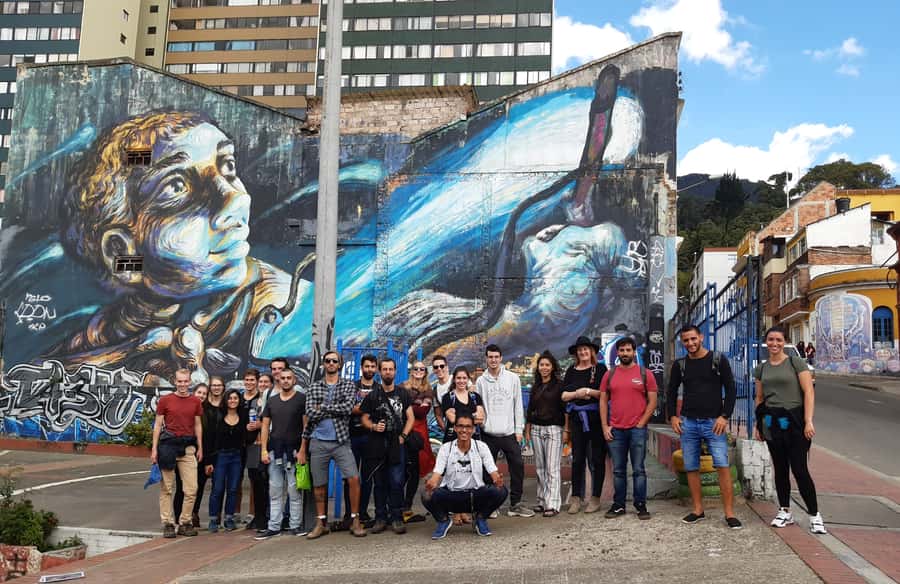
The tour is available in English and Spanish, but the two languages may be used together when the group requires it. If you speak one language fluently, this should be manageable. Still, bilingual explanations can make the walk longer and occasionally less smooth.
I would choose the departure that best fits your energy and schedule, but I would also leave room for stops. The tour lasts 150 minutes, and that includes walking, explanations, photographs, the market, Journalist’s Park, and the café tasting. It is not a rushed sprint, yet you should not plan another fixed activity immediately afterward.
Stay with the group. The operator specifically asks participants not to walk away, which is sensible in a busy central district. Keep your phone and valuables secure, follow the guide’s directions, and do not wander off while taking photographs.
Bring sunscreen and weather-appropriate clothing. Bogotá can feel cool, but you are outside for most of the experience. Comfortable shoes matter more than stylish ones. The included umbrella is helpful, but it should not replace a light rain layer if the forecast looks wet.
Free cancellation is available up to 24 hours before the tour for a full refund. You can also reserve and pay later, which is useful if your plans in Bogotá are still shifting.
Who will enjoy this tour most
I would recommend it most strongly to first-time visitors who want a cultural introduction to Bogotá that feels local and active. It is also a smart choice if you have limited time. A single walk covers La Candelaria, La Concordia Market, Journalist’s Park, several artists, and a local drink.
Art lovers will get the most from the tour, especially if you enjoy learning about process, symbolism, and public art movements. It also suits anyone interested in Colombian politics, Indigenous identity, women artists, or the way cities tell stories through walls.
Photographers should bring a camera, but the guide’s explanations are the real attraction. If you only want to collect pictures quickly, a self-guided walk may be faster. If you want to understand the pictures, this tour is a better choice.
The experience may be less suitable for anyone who dislikes walking, frequent stops, or bilingual commentary. It is also not a food tour, and the coca tea tasting is modest. Think of it as an art and culture walk with one local refreshment at the end.
Should you book the La Candelaria graffiti tour?
Yes, if you want Bogotá’s street art to mean more than colorful walls. The strongest part is the interpretation: guides such as Juana, Luis, Christian, Lorena, and Bernardo have been praised for explaining the political and cultural background in a friendly, engaging way.
Book it early in your Bogotá stay if possible. The tour can help you understand the city’s downtown, and you may return later to photograph or revisit the works that caught your eye. Choose it with realistic expectations: the route is on foot, the weather may change, and English and Spanish may be combined.
For $16, the guide, small group, local art focus, and coca tea make this one of the better-value introductions to La Candelaria. I would book it for the stories behind the murals, not just the murals themselves.
FAQ
Where does the Bogotá graffiti tour begin?
It begins next to the fountain by the yellow umbrella in Plaza del Chorro de Quevedo.
What time does the tour start?
Departures are available every day at 10am and 2pm.
How long does the tour last?
The tour lasts 150 minutes, or two and a half hours.
Is transportation included?
No. Transportation is not included, so you must reach the meeting point on your own.
Which languages are available?
The tour is offered in English and Spanish. Depending on the group, both languages may be used during the same departure.
What is included in the price?
The price includes a Gran Colombia Tours guide, explanations of the socio-political context of Bogotá’s street art, visits to graffiti works in downtown Bogotá, a Colombian tea tasting, all-risk insurance, and an umbrella in case of rain.
Can I cancel the booking?
Yes. You can cancel up to 24 hours in advance for a full refund. You can also reserve now and pay later.
Just added around Bogota
- Zipaquirá: Private Salt Cathedral Mine and Walking Tour★ 4.8 · 3 reviews
- Walking tour José Celestino Mutis Botanical Garden 3 hrs★ 5.0 · 3 reviews
- Bogota: East Hills Mountain Hike★ 4.2 · 3 reviews
- Fun Graffiti Workshop: The Art of Aerosol and Color★ 5.0 · 3 reviews
- Bogota: Explore the forest and bird watching at Chicaque Natural Park★ 5.0 · 3 reviews
- Bogota: Downtown City and Monserrate Hill Private Tour★ 3.7 · 3 reviews
- Bogotá: La Candelaria Food Tour with Tastings★ 4.2 · 3 reviews
- Bogotá: Candelaria Tour with Cacao and Coffee Workshop★ 5.0 · 3 reviews
Comuna 13 & Street Art Tours, compared.
Comuna 13 Graffiti Tour, Cable Car & Street Food
Read our review →
Private City Tour with Metrocable and Comuna 13
Read our review →
Comuna 13 Tour with Snacks And Your Own Graffiti
Read our review →
Comuna 13 and Graffiti Guided Tour with a Local
Read our review →
Browse the lists this tour appears in