
Reviewed · HISTORICAL TOURS
Historical tour Bogota
Bogotá’s past is written into its streets. This three-hour walk through La Candelaria, La Concordia, and Las Aguas connects grand political buildings with markets, murals, legends, and everyday city life. I like the way the tour moves beyond colonial architecture, explaining El Dorado, independence, the Bogotazo, Colombian violence, Botero, and Gabriel García Márquez in one clear route. I also like the practical finish, with advice on museums, restaurants, coffee, money exchange, and getting around.
The main drawback is the pace. Eight stops in about three hours means plenty of ground and a lot of information, but limited time inside any one place. The walk continues in bad weather, so bring an umbrella and wear shoes suited to uneven city streets.
In This Review
- Key things to know before you go
- Why this Bogotá walk makes sense early in your stay
- Starting at Plaza de Bolívar
- Teatro Colón and the Bolívar connection
- The Banco de la República museums area
- Chorro de Quevedo and the story of chicha
- La Concordia Market for a local taste
- Eje Ambiental and the Monserrate view
- The Gaitán monument and the Bogotazo
- Rosario Square and emeralds
- What the $19.77 price really buys you
- Pace, weather, and practical comfort
- Who will get the most from this experience
- Should you book the Bogotá historical tour?
- FAQ
- How long does the Bogotá historical tour last?
- Where does the tour begin?
- Where does the tour end?
- What places are visited?
- Are admission tickets included?
- Does the tour operate in bad weather?
- How large can the group be?
- Can I cancel for a full refund?
Key things to know before you go
- Eight stops in three hours: The route covers Bolívar Square, Teatro Colón, the Banco de la República museums area, Chorro de Quevedo, La Concordia Market, the Eje Ambiental, the Gaitán monument, and Rosario Square.
- History with a wide lens: You hear about Indigenous Bogotá, El Dorado, Spanish colonization, independence, the Bogotazo, Colombian violence, art, literature, food, and education.
- A practical introduction to the city: The final recommendations can help you choose restaurants, museums, cafés, and other places for the rest of your stay.
- A true walking experience: Transportation between sights is not included because the center is explored on foot. A moderate level of fitness is recommended.
- Small enough to remain manageable: The maximum group size is 30 people, with group discounts available.
- Strong value at $19.77: Admission to the listed stops is free, and the price covers a guide and the walking route rather than separate museum tickets.
Why this Bogotá walk makes sense early in your stay
I would use this tour as a first look at Bogotá’s historic center. The route gives you names, dates, political turning points, artistic references, and basic local advice before you set out on your own.
That matters in Bogotá because the center is not simply a collection of attractive old buildings. Plaza de Bolívar can look like a photo stop until someone explains its role in national government. Chorro de Quevedo can feel like a small meeting place until you hear why it is linked with the city’s foundation. The tour gives these places a story, which makes later independent visits more rewarding.
The historical range is unusually broad for a short walk. You move from Indigenous life and the El Dorado legend to colonization, independence, the Bogotazo, and Colombia’s long period of violence. The guide also brings in Fernando Botero and Gabriel García Márquez, along with art, food, education, architecture, and modern life.
The result is not a specialist history lecture. It is a city orientation with enough context to help you understand what you are seeing. Guides such as Paula, Jennifer, Ricardo Jiménez, Diane, Rodrigo, Carlos, and Diana have received praise for clear explanations, friendly conversation, and strong command of Bogotá’s story. Since guides vary by departure, your experience will depend partly on who leads your group.
More history-led tours:
- Shared Tour of Bogota’s Historic Downtown (La Candelaria)
★ 4.7 · 100 reviews - 7-hour City Tour of Historic Bogotá with Monserrate
★ 4.7 · 47 reviews - From bogota: Salt Cathedral tour a Cultural Heritage Tour
★ 4.5 · 23 reviews
Starting at Plaza de Bolívar
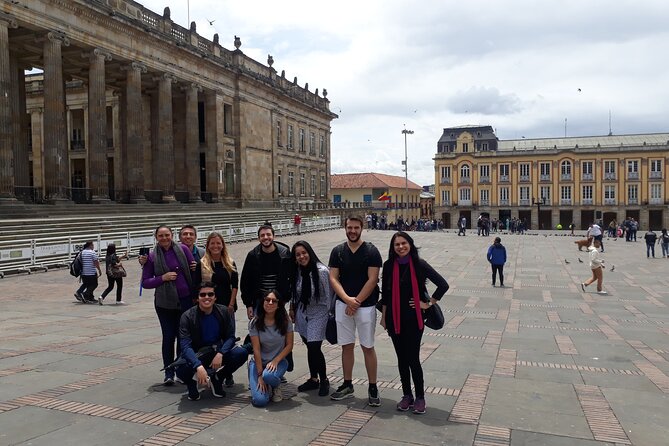
The meeting point is Cra. 7 #11-10 in La Candelaria. The first stop, Plaza de Bolívar, receives about 30 minutes and sets up the whole tour.
Here you learn how Bogotá began and see some of the country’s most important buildings. The square is the right place for that opening because political power, religion, and the city’s colonial roots come together in one public space.
I like that the guide starts with the city itself instead of rushing straight to a famous personality or a postcard view. You get the basic framework first: Indigenous Bogotá, the Spanish arrival, the development of the capital, and the forces that shaped Colombia.
Admission is free, but this is an outdoor stop. The square can also be busy, and 30 minutes is enough for explanation and photographs rather than a detailed look at every building. Keep listening while taking pictures, since the value here comes from the setting and the guide’s interpretation.
Teatro Colón and the Bolívar connection
The walk continues to Teatro Colón for about 15 minutes. You can admire one of Colombia’s important cultural buildings and learn about the place connected with Simón Bolívar’s residence.
This is a brief stop, so expect an exterior visit rather than a full theater performance or extended interior tour. That limitation is worth knowing in advance. Still, the site adds an important cultural and political layer to the route.
Theater architecture can be easy to appreciate without context, then quickly forget. The Bolívar connection gives this stop a sharper historical purpose. It links the physical city with the period when independence movements were reshaping northern South America.
The Banco de la República museums area
From outside the Museos del Banco de la República, the guide introduces the cultural block of La Candelaria. This section takes roughly 15 minutes and includes discussion of Fernando Botero.
The stop is useful for two reasons. First, it shows that La Candelaria is not only about churches and colonial streets. It is also a center for museums, art, libraries, and public culture. Second, the Botero connection gives you a starting point for understanding one of Colombia’s best-known artists.
You do not receive museum admission as part of the tour, and the stop is made from outside. If Botero or Colombian art interests you, note the location and consider returning later on your own. The guide’s introduction can help you decide which cultural sites deserve more of your time.
A few more trips worth weighing up before you book
- Bogota: Bicycle City Tour
★ 4.9 · 2,156 reviews - Zipaquirá: Salt Cathedral Group Tour with Pickup
★ 4.8 · 1,606 reviews - Bogotá: Guided La Candelaria Walking Tour
★ 4.8 · 1,229 reviews - Bogotá: Private City Tour, Monserrate, Emerald and Botero
★ 4.9 · 798 reviews
Chorro de Quevedo and the story of chicha
Plaza del Chorro de Quevedo receives about 20 minutes. It is presented as Bogotá’s foundation square, making it one of the most important historical points on the route.
The stop also explains chicha, the traditional fermented drink associated with Bogotá, and why it was prohibited. This is one of the tour’s best examples of history meeting daily life. Food and drink often reveal social control, Indigenous traditions, changing laws, and local identity better than a list of dates can.
Chorro de Quevedo is also a place where you can pause and take in the scale of La Candelaria. The tour does not turn this into a long food tasting, so the focus remains on explanation. If you want to linger, you may need to return after the walk.
La Concordia Market for a local taste
At Plaza de Mercado La Concordia, you spend about 20 minutes inside the market. This is where you can try chicha, order a typical Colombian juice, or buy a souvenir, all at your own expense.
I like this part because it changes the rhythm of the walk. After several monuments and historical explanations, a market gives you a more ordinary view of the neighborhood. You can look at local products, ask questions, and choose whether to taste something or simply watch the activity around you.
The market stop is optional in practice because purchases are not included. Bring some Colombian currency if you want to buy a drink or souvenir, but the tour information does not specify an amount or payment method. Keep the stop brief, since the group continues after about 20 minutes.
Eje Ambiental and the Monserrate view
The Eje Ambiental stop lasts around 15 minutes and provides a view toward Monserrate. The guide explains how to reach the hill, which is practical advice if you plan to visit one of Bogotá’s best-known viewpoints during your stay.
This is a good example of the tour’s useful side. You are not only told what Monserrate is. You also receive basic direction for getting there, saving you from trying to work it out later.
The stop includes a literary connection as well. The guide points out the square where Gabriel García Márquez used to attend social meetings. That detail brings Colombian literature into the route without pulling the tour away from the city streets.
Because this is a short outdoor stop, the weather and visibility can affect what you see. The tour operates in bad weather, so pack an umbrella rather than assuming rain will cancel the walk.
The Gaitán monument and the Bogotazo
At the Jorge Eliécer Gaitán monument, the guide explains who he was and why he mattered to Colombia. You also learn about the Bogotazo and its connection to violence in Colombia. This section takes about 20 minutes.
For many people, this may be the most important historical stop. The Bogotazo was a major turning point in Bogotá, and understanding it helps explain why Colombian history cannot be reduced to colonial churches, independence heroes, and attractive old streets.
The subject is serious, but it belongs on a city tour. Bogotá’s past includes conflict and political violence, and a useful introduction should not avoid difficult chapters. Expect explanation rather than a visit designed mainly for photographs.
The guide’s quality matters especially here. Several tour experiences praise guides for making politics and history clear without becoming tiring. Paula, in particular, is noted for combining political context with literary references and a warm teaching style. Your guide may be different, but the format allows questions and discussion.
Rosario Square and emeralds
The final stop is Plazoleta del Rosario, also called Rosario Square, on Av. Jimenez de Quesada #6-71. The walk ends here after roughly 20 minutes.
The square is associated with Bogotá’s emerald market. The guide explains what emeralds mean in Colombia and how this somewhat informal trade works. You might see the market activity, though no purchase is required and buying a stone is not part of the tour price.
This is a memorable ending because it returns the tour to present-day commerce. You have moved from the city’s foundation and national politics to a product tied to Colombia’s economy and international reputation.
The guide also gives recommendations for your remaining time in Bogotá. Restaurant suggestions, coffee stops, museum ideas, and advice about exchanging money can be more useful than another monument at the end of a long walk. Write down names as you go, since the final minutes can include several recommendations.
What the $19.77 price really buys you
At $19.77 per person, the value comes from the guide, the structure, and the amount of ground covered. Admission to the listed stops is free, and food, drinks, and purchases are separate.
A self-guided walk costs less in money, but it also leaves you to connect the places yourself. Here, one route ties together Indigenous history, El Dorado, colonization, independence, Botero, García Márquez, Gaitán, the Bogotazo, chicha, and emeralds.
The advertised group limit is 30 people. That is not an intimate private walk, but it is still limited enough to be workable if the guide manages the group well. The strongest comments praise guides who were punctual, attentive, friendly, and willing to answer questions.
One participant chose to pay 50,000 Colombian pesos at the end for a three-hour tour. That appears to reflect a personal payment decision, not a stated requirement, so check the booking terms and local expectations before you go. The listed price is the amount provided for the experience.
Pace, weather, and practical comfort
You need a moderate level of physical fitness. The walk lasts about three hours and moves through several central neighborhoods, with time spent standing at outdoor sites and walking between them.
The route is near public transportation, which makes reaching the meeting point easier. The tour ends at Rosario Square, so plan your next activity from that part of La Candelaria rather than expecting to return to the starting point.
Rain does not cancel the walk. Bring an umbrella, and consider a light layer because Bogotá’s weather can shift during the day. Comfortable shoes matter more than stylish ones here.
There are no included snacks, drinks, meals, or purchases. La Concordia Market gives you a chance to buy a juice or chicha, but you pay directly. Service animals are allowed.
The tour is usually booked about eight days in advance. That does not guarantee every departure will fill, but it is a useful hint if your Bogotá dates are fixed.
Who will get the most from this experience
I would recommend this walk to a first-time visitor who wants a clear introduction before choosing museums and neighborhoods to explore in more depth.
It also suits anyone with limited time. Jennifer’s three-hour route has been used as a way to see the main historic center quickly and decide what to do next. The tour covers enough ground to help you identify places worth revisiting.
Families and mixed-age groups can also benefit because the route combines buildings, stories, art, food, politics, and practical advice. The guide’s use of questions and pictures, noted in several experiences, can make historical material easier to follow.
You may want something else if you prefer long museum visits, private guiding, or a relaxed pace with few stops. This is an overview walk. Its strength is range, not extended time at one sight.
Should you book the Bogotá historical tour?
Book it if you want a structured introduction to La Candelaria and the central districts, especially if you want history explained alongside practical advice.
The best reasons are the wide subject range, the market stop, the Gaitán and Bogotazo discussion, and the helpful finish at Rosario Square. Guides including Paula, Jennifer, Ricardo, Diane, Rodrigo, Carlos, and Diana have been praised for making the material friendly, clear, and enjoyable.
Skip it if three hours of walking sounds tiring or if you want included food, museum entry, or a private group. For most first visits, though, $19.77 is a sensible price for a well-organized orientation to Bogotá’s historic heart. Cancel at least 24 hours before the start time for a full refund, and remember that the walk continues in rain.
FAQ
How long does the Bogotá historical tour last?
The tour lasts approximately three hours.
Where does the tour begin?
It begins at Cra. 7 #11-10 in La Candelaria, Bogotá, Colombia.
Where does the tour end?
The tour ends at Rosario Square, at Av. Jimenez de Quesada #6-71 in La Candelaria.
What places are visited?
The route includes Plaza de Bolívar, Teatro Colón, the Banco de la República museums area, Plaza del Chorro de Quevedo, Plaza de Mercado La Concordia, the Eje Ambiental, the Jorge Eliécer Gaitán monument, and Plazoleta del Rosario.
Are admission tickets included?
The listed stops have free admission, and the experience includes a guide and a walking tour of the central areas. Food, drinks, meals, and personal purchases are not included.
Does the tour operate in bad weather?
Yes. The tour is not cancelled because of bad weather, so you should bring an umbrella.
How large can the group be?
The maximum group size is 30 people.
Can I cancel for a full refund?
Yes. You can receive a full refund if you cancel at least 24 hours before the experience start time. Cancellations or changes made less than 24 hours in advance are not accepted for a refund.
Just added around Bogota
- Zipaquirá: Private Salt Cathedral Mine and Walking Tour★ 4.8 · 3 reviews
- Walking tour José Celestino Mutis Botanical Garden 3 hrs★ 5.0 · 3 reviews
- Bogota: East Hills Mountain Hike★ 4.2 · 3 reviews
- Bogota: Explore the forest and bird watching at Chicaque Natural Park★ 5.0 · 3 reviews
- Fun Graffiti Workshop: The Art of Aerosol and Color★ 5.0 · 3 reviews
- Bogota: Downtown City and Monserrate Hill Private Tour★ 3.7 · 3 reviews
- Bogotá: La Candelaria Food Tour with Tastings★ 4.2 · 3 reviews
- Bogotá: Candelaria Tour with Cacao and Coffee Workshop★ 5.0 · 3 reviews
Historical Tours, compared.
Historic Center and Getsemaní Shared Walking Tour
Read our review →
History & Local Life Essentials Tour on an E-Bike
Read our review →
Historical Shared Tour Salsa, Graffiti & Resistance in Cali
Read our review →
Shared Tour of Bogota’s Historic Downtown (La Candelaria)
Read our review →
Browse the lists this tour appears in